

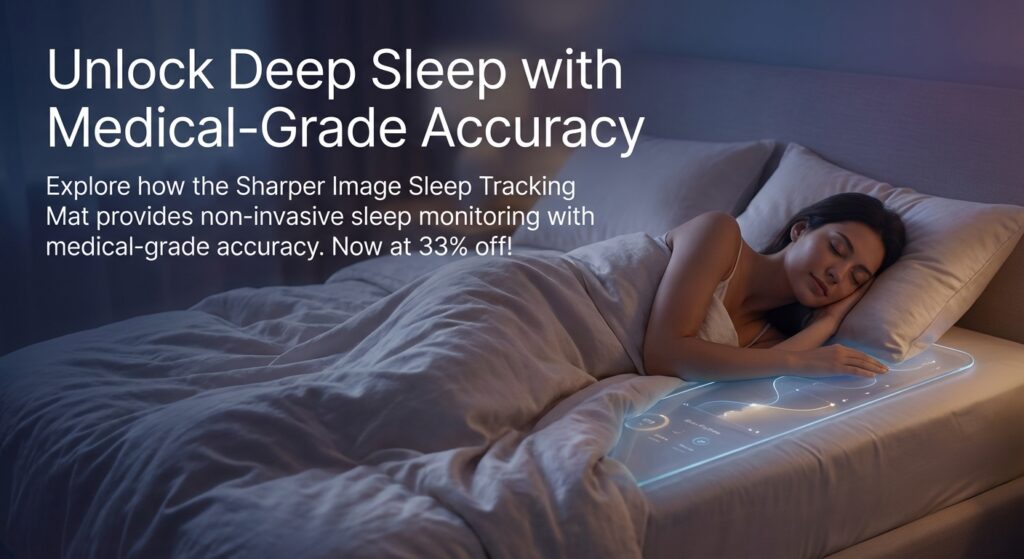
The Sharper Image Sleep Tracking Mat slides under your mattress and logs heart rate, breathing and sleep stages without a wristband. It is comfortable and genuinely passive — but published validation studies of the ballistocardiography it relies on are far less flattering than the product page. Here is what it does well, and where it should not be trusted.
What the Sharper Image Sleep Tracking Mat actually is
It is a thin sensor pad that goes between your mattress and its base. Nothing touches your skin, nothing needs charging every night, and there is no ring to lose. The mat measures the small mechanical movements your body makes while breathing and shifting, then pairs to the Withings Health Mate app over Wi-Fi to turn those signals into a nightly report.
That is the entire proposition, and it is a genuinely attractive one. Wearables fail for boring reasons — they need charging, they irritate skin, people take them off. A mat has none of those failure modes. The question is not whether it is convenient. The question is whether the numbers it produces are accurate enough to act on.
How ballistocardiography works — and why that matters
Every heartbeat and breath produces a tiny recoil in the body. Ballistocardiography picks that up as a mechanical signal rather than an electrical one. Put a sensitive sensor under a mattress and you can, in principle, detect when someone is in bed, roughly how they are breathing, and whether they are moving.
What it cannot easily do is separate quiet wakefulness from light sleep. Both look similar from below a mattress: still body, steady breathing. That single ambiguity is the root of almost every accuracy problem this class of device has, and it is not a manufacturing defect — it is a limit of the signal.

A mattress sensor infers sleep from movement and breathing, not from brain activity.
What a bed sensor can and cannot see
It sees motion, respiration and cardiac recoil. It does not see brain waves, eye movement or muscle tone — the four signals polysomnography actually uses to define sleep stages.
That gap is the whole story. The mat is inferring stage from a proxy, and the proxy is weakest exactly where light sleep and quiet wakefulness look identical.
Want the sleep basics that do not depend on a sensor? Consistency, light exposure and temperature move sleep more reliably than any tracker reading.
Read the evidence-based sleep guide →
No product required.
What the research actually says about accuracy
The product page claims “medical-grade accuracy” and comparison with the Fitbit and Oura Ring. Independent validation studies of the same technology tell a different story, and it is worth reading them before spending anything.
The most direct comparison is a validation study of a ballistocardiographic sleep tracker against polysomnography — the laboratory standard. In the participants where it produced usable data, it overestimated total sleep time by about 178 minutes per night and underestimated time awake after sleep onset by roughly 45 minutes. Agreement with polysomnography on whether a person was asleep or awake was poor (kappa = 0.13), and it could not distinguish sleep stages at all (J Clin Sleep Med, 2022).
That is not an outlier. A separate evaluation of a consumer ballistocardiographic home monitor reached the blunt conclusion that it “is not a valid device to monitor sleep”, having overestimated total sleep time and total sleep efficiency while failing to detect REM entirely (J Clin Sleep Med, 2019).
The picture does not improve when you look at consumer trackers as a class. A 2024 evaluation of three commercial wearables found reasonable agreement on total sleep time but materially worse performance on wake detection and staging (Sensors, 2024), and a five-device comparison against research-grade equipment reached a similar conclusion (Sensors, 2024). A living umbrella review of wearable validation studies concluded that performance varies so widely by device and by metric that no blanket claim is defensible (Sports Med, 2024).
None of those studies tested this exact mat. But they tested its sensing principle, and the failure mode is consistent: a mattress sensor struggles to separate still, awake time from light sleep. If you lie awake for an hour without moving much, a bed sensor tends to score it as sleep.
| Device class | Design | Main finding | Confidence |
|---|---|---|---|
| Ballistocardiographic mat (EMFIT QS) | Validation vs polysomnography | Overestimated total sleep by ~178 minutes; kappa 0.13 for sleep/wake; no stage discrimination | Strong negative |
| Consumer ballistocardiographic monitor | Validation vs polysomnography | Overestimated total sleep and efficiency; failed to detect REM; “not valid” | Strong negative |
| Contactless consumer trackers | Systematic evaluation | Variable accuracy; stage estimates weakest, sleep/wake estimates better | Mixed |
| Wrist wearables (Fitbit class) | Systematic review & meta-analysis | Reasonable total sleep time; poor at wake detection and light-sleep staging | Mixed |
| Commercial sleep devices broadly | Living umbrella review | Performance varies widely by device and by metric; no class is uniformly accurate | Mixed |
Sources: PMID 34705630 · PMID 30853052 · PMID 37430756 · PMID 31778122 · PMID 39080098
What this mat is genuinely good at
Accuracy is not the only thing a tracker can be good at, and the honest case for an under-mattress sensor is real. It removes every friction point that makes wearables fail.
- You cannot forget to wear it. No charging, no straps, no ring left on the nightstand.
- It measures the room, not the wrist. Bed presence, restlessness and ambient conditions are captured passively.
- Snoring and breathing patterns are detectable in principle — the same signal that carries heartbeat and movement also carries breathing effort.
- Comfort is not a compromise. Nothing contacts the skin, which matters if you have sensitive skin or a partner who dislikes wearables.
- Trends over weeks are more useful than any single night. Whatever the absolute error, a consistent direction of change still tells you something.
Where it falls short — and why that is structural
These are not bugs that a firmware update fixes. They follow from measuring through a mattress.
- Sleep staging is unreliable. Two independent studies found the technology could not separate light sleep from REM or from still wakefulness.
- Total sleep time tends to be overstated. If you lie awake quietly, the mat is likely to score it as sleep — which is the opposite of what an insomniac needs to see.
- It cannot diagnose sleep apnea. The company does not claim it does, and no bed sensor replaces a sleep study. If you snore heavily, gasp, or wake unrefreshed, that is a clinical question, not a gadget question.
- It stops when you leave. Getting up mid-night can pause tracking, so split nights read as one block.
- Setup is a two-person job for some. Lifting a mattress is awkward, and the pad has to sit flat or the signal degrades.
- It is not portable. Mains power plus mattress placement means it stays home.
If you suspect a breathing disorder, the route is a clinician, not a mat. Our guide to sleep apnea warning signs and treatment covers what actually warrants a referral, and how sleep architecture works explains why stage estimates are the hardest thing to get right.
How it compares to the alternatives
There are three realistic ways to track sleep without a wristband, and they fail in different ways. This is the comparison that matters, not the marketing one.
| Sleep mat | Wrist wearable | Smart ring | |
|---|---|---|---|
| Worn on body | No | Yes, all night | Yes, all night |
| Charging | Mains powered | Every few days | Every few days |
| Sleep staging | Weak — cannot reliably separate light sleep, REM and quiet wake | Moderate; best on total sleep time | Moderate; better than most wearables |
| Detects leaving bed | Yes | Yes | Yes |
| Partner disturbance | None | Can catch on bedding | Minimal |
| Travel | No | Yes | Yes |
| Best use | Passive long-term trends at home | Activity plus rough sleep | Sleep focus with some tolerance for cost |

The sensor sits between mattress and base. Placement has to be flat, or the signal degrades.
What the nightly report looks like
Data lands in the Withings Health Mate app: time asleep, time awake, restlessness, and an estimate of light, deep and REM stages. Heart rate and breathing rate are reported alongside.
The overall shape of a night is usually credible. The specific stage boundaries are where the accuracy problem shows up — treat those numbers as approximate, not diagnostic.
Why the app matters more than the mat
A sensor produces a signal. Software decides what that signal means. The same raw data can be scored conservatively or generously, and bed sensors have historically been scored generously — which is why sleep time tends to be overstated rather than understated.
If you already use a Withings scale or blood pressure monitor, the data consolidates in one place, which is a genuine practical advantage. If you use an Oura or Apple ecosystem, it does not.

Sleep reports consolidate with other Withings devices if you already own them.
Price, value and whether the discount is real
The mat is listed at $132.59 with a 33% reduction and a promotional code, bundled with a $25 gift card. That puts it well below a smart ring and far below a sleep study. If you accept that you are buying convenience and trends rather than clinical accuracy, the price is defensible.
If you are buying it hoping to find out why you wake up tired, that is the wrong purchase. The money is better spent on the fundamentals first, and the evidence for those is much stronger than the evidence for any consumer tracker.
Start with the things that actually change sleep. A consistent wake time, morning light, a cool dark room and less late caffeine outperform any device you can buy.
Free, and supported by better evidence than the tracker.
For persistent insomnia specifically, the first-line treatment is not a gadget — it is cognitive behavioural therapy for insomnia, which outperforms sleep medication over the long run. Our breakdown of insomnia solutions and CBT-I is the place to start, and why a consistent bedtime matters more than total hours explains the single highest-yield habit.
Who this mat suits
- You want passive, zero-effort tracking. If wearables end up in a drawer, this solves the real reason.
- You already use Withings products. The data consolidates with a scale and blood pressure monitor you may own.
- You want week-to-week trends, not nightly verdicts. Direction of travel is more trustworthy than any single night’s score.
- You share a bed and reject wrist devices. Nothing contacts the skin, and it will not snag bedding.
- You accept the limits. Bought as a convenience device, it is fine. Bought as a diagnostic, it is not.
Who should skip it
- You are trying to diagnose insomnia. Overstated sleep time is actively unhelpful if you are anxious about how little you sleep.
- You suspect sleep apnea. Snoring and gasping need a clinical assessment, not a mat. See the warning signs that warrant a referral.
- You need accurate stage data. No bed sensor in this class delivers it, and the validation studies are unambiguous.
- You travel constantly. Mains power and mattress placement make it a fixed installation.
- You want one device for activity too. It tracks sleep in bed, nothing else.
- You need a number you can show a doctor. Consumer tracker output is not a clinical measurement; bring symptoms, not screenshots.
- You dislike subscriptions on principle. This one has none, which is genuinely rare in this category.
- Your mattress is older or slatted. Uneven support is where most bed sensors fail.
Frequently asked questions
Does the Sharper Image Sleep Tracking Mat really have medical-grade accuracy?
No. That is a marketing phrase, not a regulatory claim. Independent validation of ballistocardiographic sleep trackers found poor agreement with polysomnography on sleep versus wake, and no reliable sleep-stage detection. It is a consumer wellness device, not a medical one.
Can it diagnose sleep apnea?
No, and the manufacturer does not claim it can. It may flag snoring or irregular breathing patterns, but diagnosis requires a sleep study. If you gasp, choke, or wake unrefreshed despite adequate time in bed, get assessed.
Do I need a subscription or a phone nearby?
No subscription is required for the core sleep reports. The mat talks to the Withings Health Mate app over Wi-Fi, so you do not need your phone beside the bed, though you do need a mains outlet and a home network.
Will it work with a thick mattress or an adjustable base?
This is the most common practical failure. The pad must sit flat and in contact with a stable surface. Very thick mattresses, adjustable beds that articulate, and slatted bases can all degrade the signal. Check the placement guidance for your specific bed before buying.
What happens if two people share the bed?
A single mat is calibrated for one sleeper. If you need both partners tracked, you generally need two units, and the app has to distinguish them. Partner movement can also register on your mat.
Is tracking your sleep actually useful?
It can be, with a caveat worth taking seriously: orthosomnia — anxiety caused by chasing perfect sleep scores — is a documented phenomenon. If the data makes you more anxious about sleep, the data is hurting you. The sleep and metabolism connection is real, but it is driven by sleep itself, not by measuring it.
How does it compare with a sleep ring?
A ring measures from the finger, which gives a stronger pulse signal, and it travels. A mat measures through a mattress, which is more comfortable but weaker on staging. If you want a ring specifically, our Ultrahuman Ring AIR review covers the trade-offs in the same evidence-first way. White noise machines and melatonin are separate decisions again — neither is a substitute for the fundamentals.
Verdict
6/10
Comfortable and genuinely passive — but not an accurate sleep lab
As a convenience device that removes every friction point of a wearable, it works. As a source of trustworthy sleep-stage data, the published evidence for its sensing principle is poor, and the “medical-grade accuracy” claim does not survive contact with the literature.
Buy it if you want effortless trend tracking and will treat the numbers as directional. Skip it if you have insomnia, suspect apnea, or need stage-level accuracy.

Current offer: $132.59 with the seasonal discount code, plus a $25 gift card bundle.
AllAboutHealthToday may receive a commission at no additional cost to you. This is a wellness device, not a medical device.
The bottom line
Sleep tracking is a crowded category full of confident numbers and thin evidence. This mat is a well-executed version of a sensing approach that has repeatedly underperformed in validation studies. That does not make it useless — it makes it a comfort and trend tool, which is what most people actually want from a sleep gadget.
The honest advice is unglamorous: fix the fundamentals first, because the evidence there is far stronger. If you still want passive tracking after that, this is a reasonable way to get it. If you are looking for an explanation of why you feel terrible in the mornings, a $132 mat is not going to give you one — a clinician might.
For the broader picture, see whether a CGM is worth it if you are not diabetic — the same question of data versus action applies to every consumer health device you might buy.