

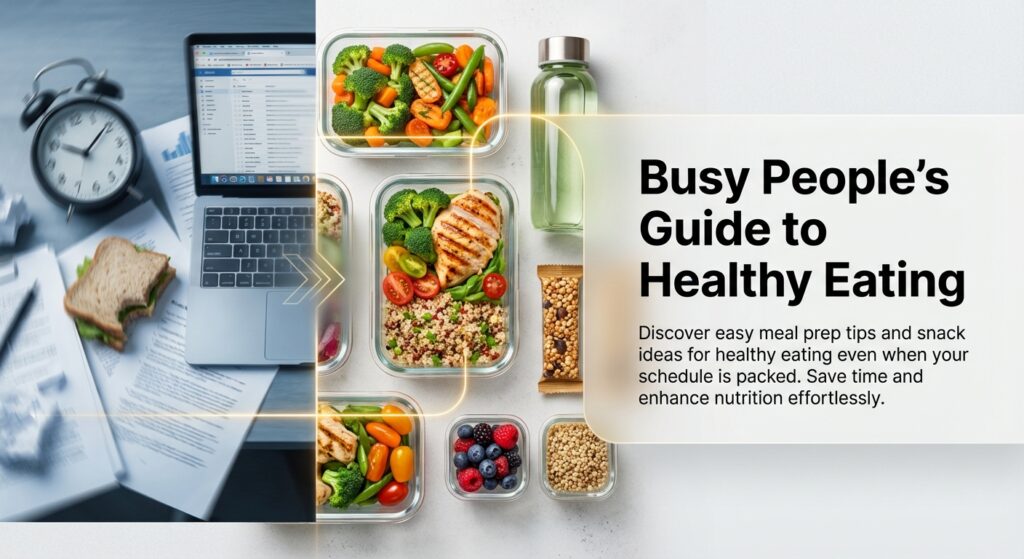
Healthy eating fails on time, not knowledge. Almost everyone knows what to eat; the problem is that cooking competes with everything else at 7pm. The fix is not discipline — it is choosing meals whose prep time matches the minutes you actually have.
Medically reviewed by Dr. A. Collins, MDBoard Certified Internist · Updated 26 October 2026
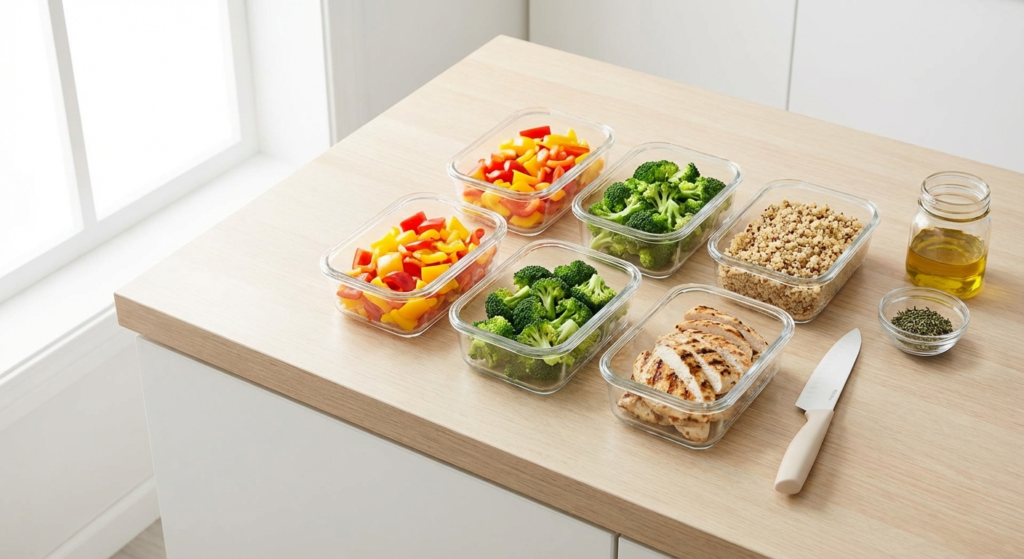
Frequency of cooking at home is associated with better diet quality, and people who cook less often tend to have poorer diets overall (Wolfson, 2022). Employment and time pressure are consistently identified as barriers, and food skills matter more than motivation (Fernandez, 2019).
So treat this as a scheduling problem. Decide what fits your real evening, then repeat it.
Match the meal to your minutes
Tell this tool how long you actually have and what you have in, and it will tell you which approach to use.
Built around the components that make a meal hold: protein, fibre, and something with volume.
What a fast meal still needs
Speed changes the format, not the requirements. Every meal that actually satisfies has three components, and each has a zero-effort version.
- A protein anchor. Tinned fish, eggs, Greek yoghurt, rotisserie chicken, tofu, tinned beans. Protein is the most satiating macronutrient and spreading it across meals reduces appetite (De Leon, 2026).
- A fibre source. Frozen vegetables, bagged salad, tinned pulses, wholegrain microwave rice. Fibre slows gastric emptying and drives satiety signalling (Akhlaghi, 2024).
- Something with volume. Low energy density lets you eat a satisfying amount without a large calorie load (Ello-Martin, 2005).
- A fat or a sauce, in moderation. This is what makes it food rather than fuel. It is not the problem.
- Optional starch. Microwaved rice, pasta, bread. The carbohydrate context is in how carbohydrates work.
The four tiers of weeknight eating
- Assemble (under 10 minutes). No heat. Tinned fish or beans, bagged salad, olive oil, bread. This is a real meal and it beats a takeaway on every axis.
- One pan (15–25 minutes). Everything roasted or stir-fried together. Protein plus frozen vegetables plus a sauce. The workhorse of weekday cooking.
- Batch base (30–40 minutes once a week). Cook a large quantity of one grain, one protein and one vegetable. Three meals become assembly.
- Proper cooking (an hour or more). Weekend territory. Worth it when you have the time, not a standard to fail at on a Tuesday.
What batch prep actually saves
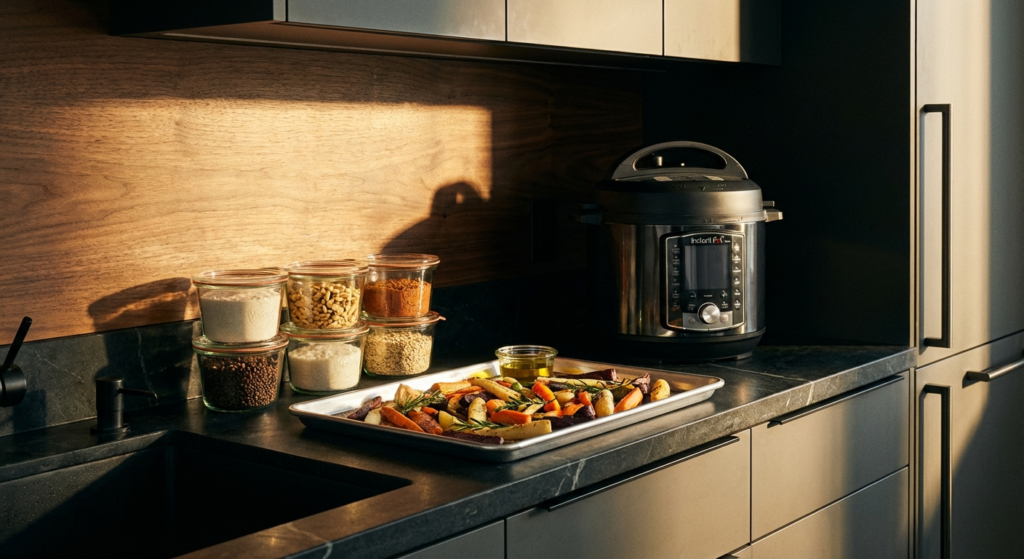
Batch cooking is often oversold as a Sunday ritual requiring four hours. The version that survives real life is smaller: cook components rather than finished meals, because finished meals become boring by Thursday.
A tray of roasted vegetables, a pot of grains and a protein will recombine into different meals. That variability is what stops batch prep from collapsing into food you avoid.
- Cook components, not meals. Grains, protein, roasted vegetables — separate containers, mixed at eating time.
- Double the base, not the whole dish. Leftover rice or lentils are useful; leftover assembled plate is not.
- Keep a frozen fallback. Frozen vegetables and tinned fish mean there is always a ten-minute meal, which is what prevents the takeaway.
- Prep the friction, not the food. Washing salad and boiling eggs takes minutes and removes the reason not to eat them.
- Accept repetition at breakfast and lunch. Variety matters at dinner; decision fatigue matters more at 7am.
The convenience trap
Convenience food is not neutral. Ultra-processed products are engineered to be fast, palatable and easy to overeat, and the evidence on their health effects has strengthened considerably (Monteiro, 2025).
The honest framing is not “never use convenience food” — it is that some convenience foods are ingredients and some are products. A bag of frozen peas is a convenience ingredient. A ready meal with thirty ingredients is a product. The first saves you time; the second replaces the meal.
- Convenience ingredients: frozen vegetables, tinned pulses, pre-washed salad, rotisserie chicken, microwave grains, pre-cut fruit.
- Convenience products: ready meals, snack bars marketed as meals, flavoured instant noodles, most “protein” ready foods.
- The test: can you see what it is made of? If the ingredient list is a paragraph, it is replacing your cooking rather than supporting it.
The snack problem is a planning problem
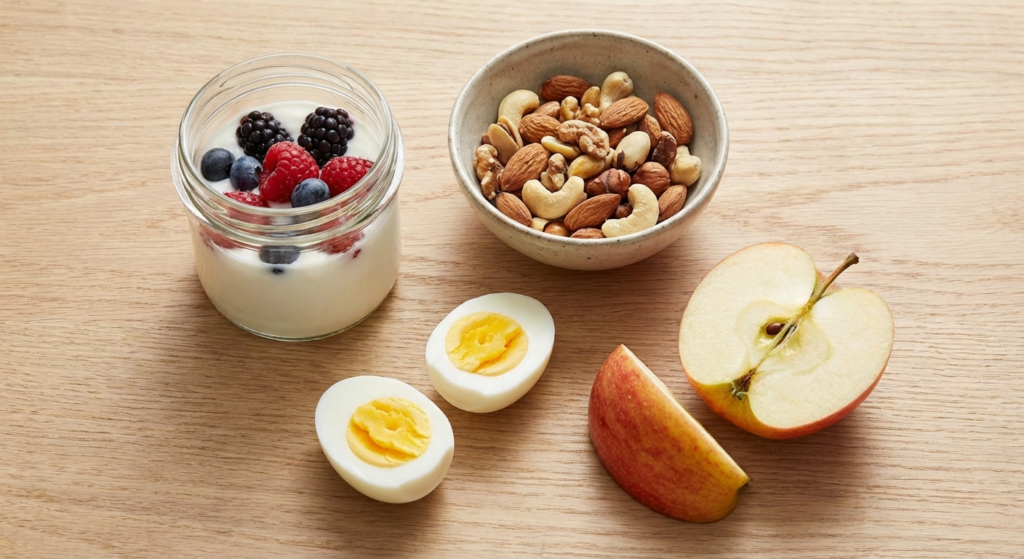
Most bad snacking happens because the good option required preparation and the bad one did not. That is a stocking decision, not a willpower failure.
The scoring logic behind a satisfying snack — protein, fibre, volume, solid form — is covered in smart snacking, and the shelf-level traps in deceptively healthy foods.
If you want meal templates rather than principles, breakfast ideas covers the meal most people skip and then overcorrect for.
The short version
Match the format to your minutes. A ten-minute assembled meal beats a forty-minute plan you abandon.
Batch components, not finished meals. Recombination is what keeps it edible by Thursday.
Convenience ingredients are allies; convenience products are substitutes. The ingredient list tells you which one you are holding.
Common questions about eating well when busy
How do I eat healthy with no time to cook?
Assemble rather than cook: tinned fish or beans, bagged salad, olive oil, bread. That is a balanced meal in under ten minutes with no heat involved.
Is meal prep worth it?
Yes if you prep components rather than whole meals. Prepping five identical containers usually fails by Wednesday; prepping grains, protein and vegetables stays useful.
Are ready meals always bad?
Not always, but they are usually ultra-processed and easy to overeat. Compare ingredient lists rather than front-of-pack claims.
What is the fastest genuinely healthy meal?
Eggs on wholegrain toast with frozen spinach, or tinned sardines with bagged salad and bread. Both take under ten minutes and contain protein, fibre and volume.
Should I skip breakfast if I am busy?
That is a preference, not a rule. If skipping leads to a large evening intake, a quick protein-containing breakfast usually works better.
How do I stop ordering takeaway?
Keep a ten-minute fallback in the house. Most takeaway happens because nothing was available, not because nothing was wanted.
Sources
- Wolfson JA, et al. Less frequent cooking dinner at home is associated with lower diet quality. J Acad Nutr Diet. 2022. PMID 35569728
- Fernandez MA, et al. Full-time employment, diet quality and food skills of Canadian parents. Can J Diet Pract Res. 2019. PMID 30724091
- Monteiro CA, et al. Ultra-processed foods and human health: the main thesis and the evidence. Lancet. 2025. PMID 41270766
- Aragon AA, et al. International Society of Sports Nutrition position stand: diets for body weight management. J Int Soc Sports Nutr. 2026. PMID 42867412
- De Leon A, et al. Evenly distributing daily dietary protein across three meals reduces appetite. J Acad Nutr Diet. 2026. PMID 42242423
- Akhlaghi M. The role of dietary fibers in regulating appetite. Crit Rev Food Sci Nutr. 2024. PMID 36193993
- Ello-Martin JA, et al. The influence of food portion size and energy density on energy intake. Am J Clin Nutr. 2005. PMID 16002828