

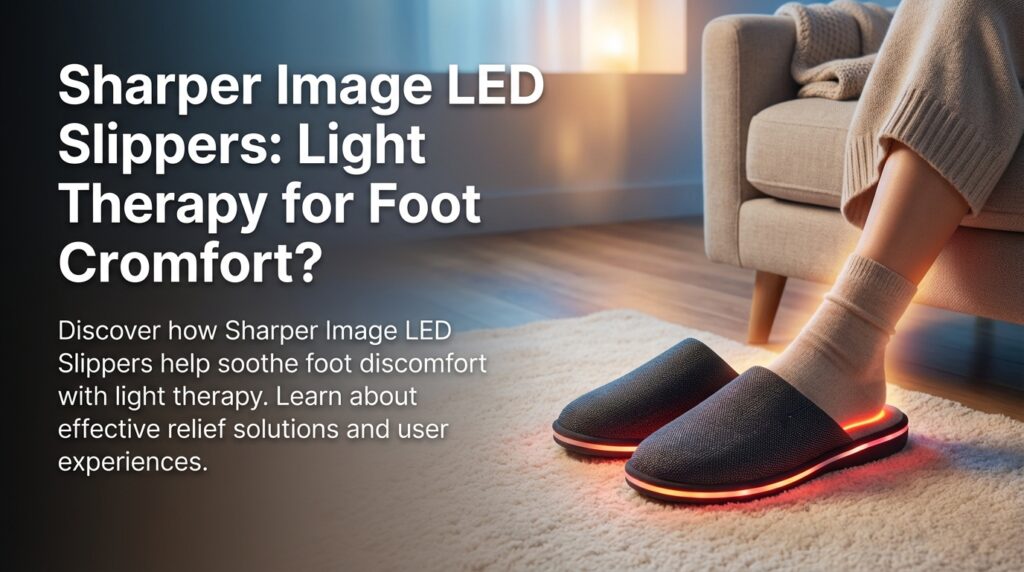
LED slippers are photobiomodulation devices that most buyers cannot dose. Clinical red-light therapy works within a specific energy window, and a consumer slipper usually does not state the irradiance needed to know whether it reaches that window. That is the review in one sentence: plausible mechanism, unverifiable dose.
Medically reviewed by Dr. A. Collins, MDBoard Certified Internist · Updated 26 October 2026

Photobiomodulation — the deliberate use of red and near-infrared light at low intensity — is a real field with real trials. It is also a field where dose determines everything, and where the effect curve is not linear: too little does nothing, and too much can be worse than nothing.
Slippers sit at the awkward end of that. They are comfortable, they cover the feet well, and they rarely publish the numbers you would need to check.
What these devices claim
- Improved circulation. Plausible via local vasodilation, difficult to demonstrate in a consumer device.
- Pain relief in the feet. The claim with the most clinical analogue — PBM has been studied for musculoskeletal pain.
- Reduced neuropathy symptoms. Studied in diabetic neuropathy with mixed results and often with clinical-grade devices.
- Faster wound healing. Real in clinical settings at specified doses; not a claim a slipper should make.
- Better sleep and “cellular energy”. Marketing language rather than measurable claims.
Note what is missing from that list: any statement of irradiance in mW/cm², any energy density in J/cm², and any reference to the trials the claims are borrowed from.
The dose problem, with a calculator
Photobiomodulation is defined by two numbers. Irradiance (mW/cm²) is how intense the light is at the skin. Energy density (J/cm²) is irradiance multiplied by time. The clinical literature generally works in the region of 1–10 J/cm² per treatment point, and the response is biphasic — there is an optimal window rather than a “more is better” relationship (Nie, 2023).
If your device does not state irradiance, the dose cannot be calculated — and that is the finding, not a limitation of this tool.
Run the numbers on a typical consumer device and the problem is immediate. If a slipper delivers around 10 mW/cm² for 20 minutes, that is roughly 12 J/cm². Change either input and the result moves by an order of magnitude. Without the irradiance figure, you are guessing.
What the evidence supports
The clinical literature on PBM is substantial but inconsistent, and the quality varies sharply by condition.
- Musculoskeletal pain: systematic reviews of low-level laser therapy report benefit in some conditions, with heterogeneity that makes generalising unsafe (Bjordal, 2011). Guidelines list it among non-pharmacological options rather than as a first-line treatment (Flynn, 2020).
- Knee osteoarthritis: studied as an adjunct to rehabilitation rather than a standalone treatment (Ahmad, 2022).
- Inflammatory arthritis: a systematic review in rheumatoid arthritis found effects worth pursuing but from small trials (Lourinho, 2023).
- Temporomandibular disorders: a scoping review of laser parameters shows how widely protocols differ — the recurring theme across this field (Bharali, 2026).
- Cosmetic claims: a recent dermatology review assessed red-light marketing claims against the evidence and found most are ahead of it (Barton, 2026).
- Skin fibrosis: mechanistic work with visible red LED exists but is at the laboratory stage (Mamalis, 2016).
Two things stand out. First, positive findings cluster in conditions studied with clinical devices at specified doses. Second, where evidence is weak, it tends to be because the intervention was under-specified rather than because the mechanism was disproved.
Why slippers are a hard case
Three practical features make feet an awkward target, and none of them are the manufacturer’s fault.
- Distance and coupling. Light intensity falls with distance and with poor contact. A slipper has gaps, and gaps mean less dose than the spec sheet implies.
- Skin thickness and pigmentation. The sole is thick stratum corneum; melanin absorbs red light. Dose at the surface is not dose at the target tissue.
- Coverage versus power. Spreading a fixed LED budget over a whole foot reduces irradiance per point. A large, dim array can be less useful than a small, bright one.
- No stated protocol. Clinical work specifies J/cm² per point and treatment frequency. Consumer products specify “15 minutes, daily”.
If you still want to try them
- Look for irradiance in mW/cm². Not wattage, not LED count. Without it, the device cannot be dosed.
- Look for wavelength. Roughly 630–680 nm for red, 800–850 nm for near-infrared. “Red light” without a number is a colour, not a specification.
- Set expectations low and time-bound. Give it four to six weeks against a symptom you have written down, then stop if nothing changed.
- Do not use it as a substitute for assessment. Foot pain and numbness have treatable causes — neuropathy, circulation, plantar fasciitis, stress fracture — and a slipper does not investigate any of them.
- Stop if pain increases. With a biphasic response, an overdose can feel worse, not better.
The verdict
Mechanism: real. Photobiomodulation has measurable biological effects and clinical trials behind it.
Device: unverifiable. Without stated irradiance and wavelength, you cannot know whether a slipper reaches a therapeutic dose.
Advice: if a manufacturer publishes irradiance, wavelength and energy density, the claim becomes checkable — and that alone is a useful filter. If they publish “red light” and a price, treat it as a warm slipper with a pleasant glow.
The second image shows the slippers in use, which is the format’s genuine advantage: hands-free, consistent contact, and easy to do daily. Adherence matters in every treatment, and a device you actually use beats a better device in a drawer.
For a broader look at red light claims beyond feet, including the muscle and recovery marketing, see red light therapy for fat loss and recovery.

If the underlying issue is foot or joint pain rather than a desire to try PBM, the better-evidenced routes are load management and strength work — see at-home strength training — and, for circulation and recovery generally, cold water immersion has clearer trial evidence than consumer red light. Magnesium and sleep both affect perceived pain, covered in magnesium types and improving sleep.
What to do instead, if the goal is less pain
Most people buying LED slippers are trying to solve foot pain, poor circulation or numbness. Those have better-evidenced routes, and they cost nothing.
- Get the diagnosis first. Foot pain and numbness can come from plantar fasciitis, neuropathy, peripheral arterial disease, a stress fracture or nerve entrapment. Each needs a different treatment, and a light does not distinguish them.
- Load management and strength work. For most musculoskeletal foot pain, progressive loading beats passive modalities — see at-home strength training.
- Aerobic activity for circulation. Walking and cycling change vascular function more than any local device — see cardiorespiratory fitness after 40 and how many steps a day.
- Sleep and magnesium. Both affect perceived pain, and both have better evidence than consumer red light — see improving sleep and magnesium types.
- Footwear. The least glamorous intervention and among the most effective. A slipper with LEDs is still a slipper.
Where red light does have a case
To be fair to the technology: the conditions where PBM has the strongest support share a pattern. The device is clinical, the dose is specified, the tissue is superficial, and the outcome is measured rather than felt.
- Superficial and accessible tissue. Skin, mucous membrane and joint surfaces respond more reliably than deep structures because the light actually reaches them.
- Protocol-driven delivery. Fixed irradiance, fixed time, fixed treatment frequency — the reproducibility is what makes trials interpretable.
- Adjunct rather than replacement. The positive trials tend to use PBM alongside rehabilitation, not instead of it (Ahmad, 2022).
That pattern is the useful filter. If a consumer product cannot tell you what it delivers, it cannot plausibly be borrowing results from studies that could.
One honest note on this article itself: the PBM literature is genuinely uneven, and several of the reviews cited here report small trials with heterogeneous protocols. That is a property of the field, not of the review.
Common questions about LED slippers
Do LED slippers actually work?
The mechanism is real but the dose is usually unstated. Without irradiance and wavelength figures, you cannot tell whether the device reaches a therapeutic window, so the honest answer is unverifiable.
What dose should I look for?
Clinical work commonly uses roughly 1–10 J/cm² per point at 630–850 nm. Multiply irradiance in mW/cm² by seconds and divide by 1000 to get J/cm².
Is more light better?
No. Photobiomodulation shows a biphasic response — there is an optimal window, and exceeding it can reduce or reverse the effect.
Can they help diabetic neuropathy?
It has been studied, mostly with clinical devices and mixed results. Numbness or burning in the feet needs medical assessment first, because treatable causes exist.
Are they safe?
Red and near-infrared light at these intensities is generally low risk. Avoid staring into the LEDs, and stop if pain worsens.
How long before I notice anything?
Give it four to six weeks against a symptom you have recorded. If nothing has changed by then, it is not working for you.
Sources
- Nie F, et al. Biphasic dose response in the anti-inflammation experiment of photobiomodulation. Lasers Med Sci. 2023. PMID 36749428
- Bjordal JM, et al. A systematic review with meta-analysis of the effect of low-level laser therapy in musculoskeletal pain. Support Care Cancer. 2011. PMID 21660670
- Flynn DM, et al. Chronic musculoskeletal pain: nonpharmacologic, noninvasive treatments. Am Fam Physician. 2020. PMID 33064421
- Ahmad MA, et al. Effects of low-level and high-intensity laser therapy as adjunctive to rehabilitation. Physiotherapy. 2022. PMID 34654554
- Lourinho I, et al. Effects of low-level laser therapy in adults with rheumatoid arthritis. PLoS One. 2023. PMID 37683021
- Bharali K, et al. Photobiomodulation for temporomandibular disorders: a scoping review of laser parameters. Cranio. 2026. PMID 42831352
- Barton NE, et al. Red light therapy in cosmetic dermatology: marketing claims backed by evidence. J Drugs Dermatol. 2026. PMID 42696344
- Mamalis A, et al. Visible red light emitting diode photobiomodulation for skin fibrosis. Curr Dermatol Rep. 2016. PMID 27182462
- Page MJ, et al. Electrotherapy modalities for adhesive capsulitis. Cochrane Database Syst Rev. 2014. PMID 25271097