
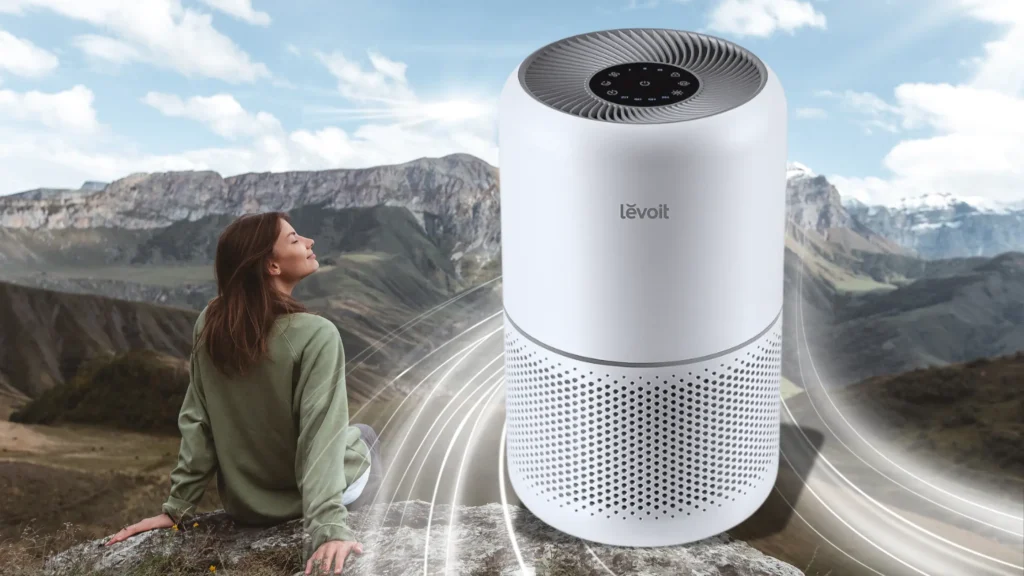
The Levoit Core 300 is the right air purifier for one specific job: cleaning a bedroom of roughly 200–250 square feet, quietly, for about $100 with no subscription and no app. It is a bad choice for a large open-plan room, and it has no air-quality sensor, so it cannot tell you when the air is dirty.
Buy it if
You want a quiet bedroom or nursery purifier with verified CADR numbers and no ongoing fees.
Best fitSkip it if
Your room is larger than ~250 sq ft, or you want auto mode and app control. That is the 300S.
LimitsThe money
Roughly $100 up front, no subscription, filters every 6–12 months. Cheap to run, not free to own.
Budget📋 Specs That Actually Matter
Marketing pages list ten specifications. Three of them decide whether a purifier works in your room: CADR, the noise floor, and what the filter actually captures.
| Specification | Core 300 | Why it matters |
|---|---|---|
| CADR (smoke / dust / pollen) | 143 / 153 / 167 CFM | Published and AHAM Verifide. This is the number that determines room size, not the marketing square footage. |
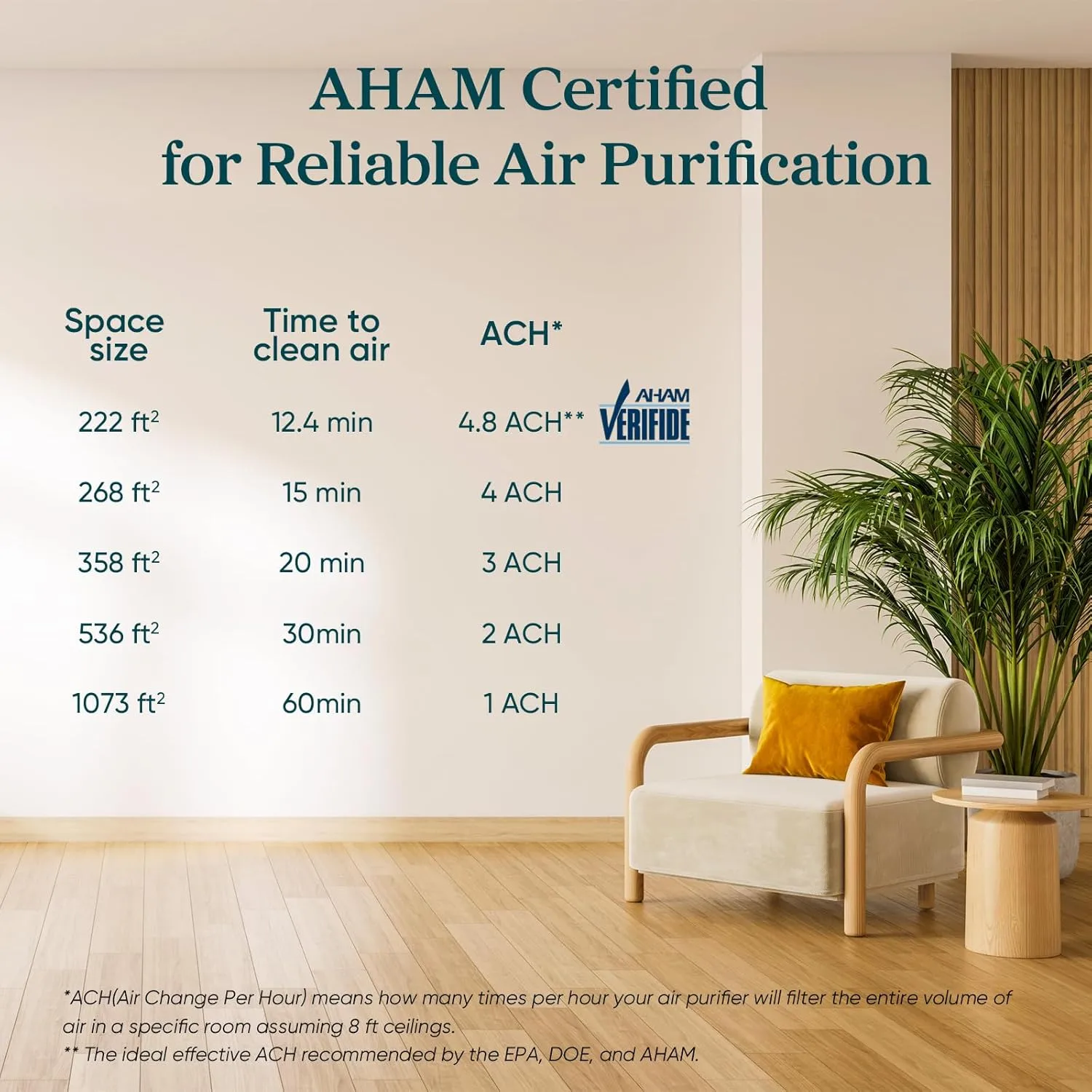
| Recommended room | ~200–250 sq ft | At 4–5 air changes per hour, which is the range allergy guidance uses. |
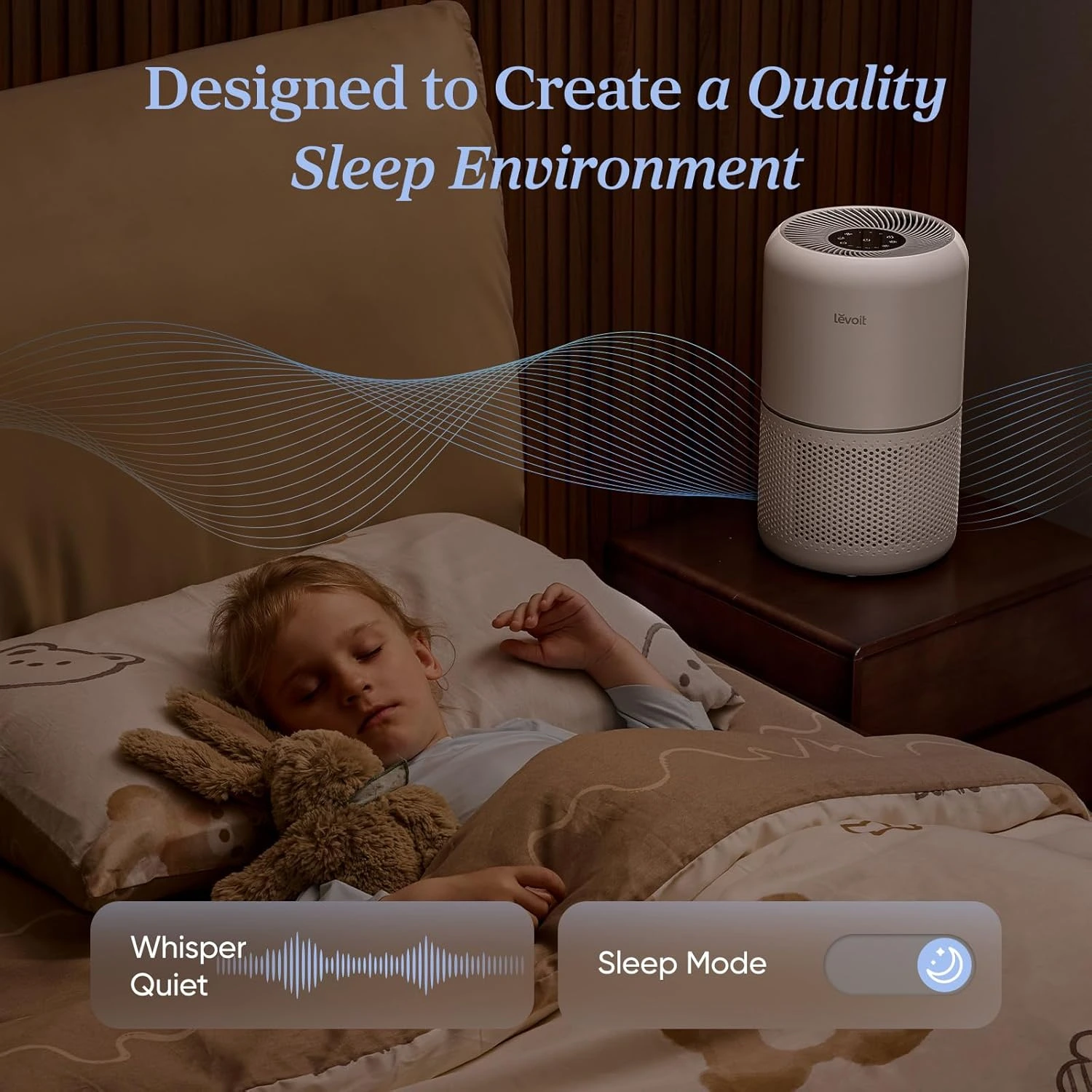
| Noise | ~24 dB sleep, mid-50s dB high | 24 dB is quieter than a library. This is why it works in a bedroom. |
| Filtration | 3-stage: pre-filter, HEPA-grade, carbon | The carbon layer handles odours and some VOCs; HEPA handles particles. |
| Filter variants | Standard, Pet, Smoke, Toxin Absorber | Pick by problem: dander, smoke, or chemical odour. Filter links are affiliate links; we may earn a commission at no extra cost to you. |
| Size and weight | 8.7 × 8.7 × 14.2 in, 7.9 lb | Small enough for a nightstand; 360° intake needs clearance on all sides. |
| Smart features | None | No sensor, no auto mode, no app. The 300S adds those. |
Setup and placement
Unboxing takes two minutes: remove the filter from its plastic bag, seat it in the base, twist the cover. The one step people skip is removing the plastic from the filter, which produces a purifier that runs quietly and does nothing for months.
Placement matters more than the speed setting. The intake is 360 degrees, so the unit needs clearance on all sides, and it works best where air already moves — a corner behind furniture is the worst spot in the room. If you sleep beside it, angle the exhaust away from your face; the airflow is gentle but perceptible at high speed.
📏 Room Sizing Without the Marketing Math
Purifier packaging quotes the largest room a unit can theoretically serve. The useful standard is air changes per hour: how many times the full volume of the room passes through the filter in an hour. Allergy guidance generally targets four to five.
Run the arithmetic once and the Core 300’s place becomes obvious. At 167 CFM for pollen, that is about 10,000 cubic feet of air per hour. A room with 8-foot ceilings at 250 square feet is 2,000 cubic feet, so you get five air changes per hour. At 500 square feet you get 2.5, which is half of what you want.
- Bedroom, up to ~250 sq ft: correct tool, runs on medium, quiet enough to sleep beside.
- Living room, 400+ sq ft: it will run, and it will help, but it will not clean the room at an allergy-grade rate.
- Open plan: wrong product. You need a unit with CADR in the 300+ CFM range, and you will pay for it.
🔬 What Air Purifiers Actually Do for Health
This is where most reviews stop at specifications. The evidence is real but narrower than the category implies, and it depends on the filter actually running.
The strongest trials are in allergy and asthma. A randomised trial of portable HEPA cleaners in homes with children who have asthma measured reductions in asthma morbidity when filtration ran consistently. Drieling, Environmental Health, 2022 A 2025 cluster-randomised trial in children found respiratory benefits from multi-setting air purification. Lei, JAMA Pediatrics, 2025
For specific allergens, controlled exposure studies show air cleaners reduce airborne cat allergen and improve allergic responses. Gherasim, Respiratory Medicine, 2025 Pollen-season trials in allergic rhinitis show symptom improvement when indoor purification runs during exposure. Li, Clinical Otolaryngology, 2020
Cardiovascular and longer-term outcomes are more speculative. A 2024 intervention study reported improvements in cardiovascular risk markers with long-term indoor purification, but these are surrogate measures rather than event reduction. Xia, Environmental Research, 2024 Cost-effectiveness modelling supports filtration where outdoor particulate levels are high. Zhang, Environmental Science & Technology, 2023
Who benefits most
Three groups get a clear return: people with allergic rhinitis whose symptoms worsen indoors, households with a cat or dog, and anyone living through wildfire season with windows shut. Outside those, the benefit is small enough that better ventilation is the cheaper intervention.
⚖️ What It Does Well, and Where It Falls Short
✓ Strengths
- Verified CADR rather than invented room-size claims
- ~24 dB sleep mode, with the display lights switchable off
- No subscription, no app, no account required
- Filter variants for dander, smoke and odour
- Cheap to run continuously
✗ Weaknesses
- No particle sensor, so no auto mode or air-quality readout
- No Wi-Fi or scheduling app
- Undersized for open-plan rooms
- Ongoing filter cost, which reviews often omit
What owners consistently report
Across the large review base, the same themes repeat, and they match the specifications rather than contradicting them.
- Sleep mode is genuinely quiet. The most consistent praise, and the reason it wins bedroom comparisons.
- The lights-off option matters more than expected. Owners in dark bedrooms mention it repeatedly, and most competitors do not offer it.
- Filter replacement is the main complaint. Not the cost so much as the reminder arriving sooner than expected in pet households.
- Missing auto mode is the most common regret. People who wanted set-and-forget behaviour should have bought the 300S.
- Room-size disappointment is predictable. Buyers who put it in an open-plan space report that it does not transform the air, which is exactly what the CADR maths predicts.
Read those together and the pattern is a product doing precisely what its spec sheet says, with dissatisfaction concentrated among people who bought it for a job it was never sized for.
💰 What It Costs to Own
| Cost | Reality |
|---|---|
| Purchase | Around $100, occasionally less on promotion. No subscription tier exists at any price. |
| Filters | The real recurring cost. Replace every 6–12 months, sooner with pets, dust or wildfire smoke. The filter indicator will prompt you. |
| Electricity | Negligible next to filters. Running a small purifier continuously costs less than most people assume. |
Budget for one filter a year and the three-year total still lands well under what a subscription-based purifier costs, which is the Core 300’s strongest argument.
⚖️ Core 300 vs 300S vs Blueair
| Option | Choose it when |
|---|---|
| Core 300 | You want the cheapest verified bedroom purifier and do not need an air-quality sensor. |
| Core 300S | You want auto mode and app control, and will pay for the sensor that makes auto mode work. |
| Blueair units | You want higher CADR for a larger room. See our Blueair review for the trade-offs. |
🔄 If This Is Not the Right Purifier
Two situations justify spending more, and neither is subtle.
- You have a large or open-plan room. You need CADR well above 200 CFM. A higher-capacity unit running on medium is quieter and more effective than a small unit running flat out, and it extends filter life. Our Blueair review covers the step up.
- You want the purifier to respond to air quality on its own. That requires a particle sensor, which the Core 300 does not have. The 300S is the same chassis with the sensor and app added.
If your actual complaint is breathing difficulty rather than dust, a purifier is the wrong first purchase. Respiratory health is the better starting point, and waking at night covers the sleep side.
Verdict: is the Core 300 still worth buying in 2026?
Yes, for a bedroom, at this price, with no subscription. It is not the most capable purifier you can buy and it is not trying to be. What it does well is the thing most people actually need: quiet, verified filtration in a small room, cheaply, without an account.
❓ Frequently Asked Questions
Roughly 200 to 250 square feet at four to five air changes per hour, which is the rate allergy guidance targets. Marketing may quote a larger figure. Above about 250 square feet it still runs and still helps, but it stops cleaning the whole room at that rate.
Every 6 to 12 months. Go closer to six if you have pets, live somewhere dusty, or run it through wildfire season. The unit has a filter-change indicator, but it estimates runtime rather than measuring the filter, so a visibly grey cartridge should be replaced even if the light is off.
The activated carbon layer handles cooking smells, pet odour and some volatile organic compounds. It is not a strong chemical filter. If smoke or VOC removal is the priority, use the Smoke or Toxin Absorber cartridge and accept that carbon saturates faster than HEPA.
The 300S adds a particle sensor, auto mode and app control. Auto mode is the only feature that changes how the unit behaves rather than how it is controlled, and it is worth the premium if you want the purifier to ramp up on its own. If you will set a speed and leave it, the plain 300 is the better buy.
Yes, and that is the intended use. Sleep mode sits around 24 dB, and the display lights can be switched off completely. If you are sensitive to fan noise, the trade-off is that the quietest setting moves the least air, so a smaller room suits it better than a large one.
Much less so. The strongest evidence is for allergic rhinitis and asthma where the trigger is airborne indoors. For everyone else the benefit is smaller and harder to measure, and the money usually does more good spent on ventilation. If you live with wildfire smoke or heavy traffic pollution, the case gets stronger.
Sources
- Drieling RL, et al. Randomised trial of a portable HEPA air cleaner intervention to reduce asthma morbidity. Environmental Health, 2022. PMID 34980119
- Lei J, et al. Respiratory benefits of multisetting air purification in children: cluster randomised trial. JAMA Pediatrics, 2025. PMID 39621320
- Gherasim A, et al. Efficacy of air cleaners to reduce allergic responses to cat: randomised clinical trial. Respiratory Medicine, 2025. PMID 40246248
- Li L, et al. Efficacy of indoor air purification in Artemisia pollen-allergic rhinitis. Clinical Otolaryngology, 2020. PMID 32058675
- Xia X, et al. Effects of long-term indoor air purification intervention on cardiovascular health. Environmental Research, 2024. PMID 38253196
- Zhang A, et al. Air purifier intervention to remove indoor PM2.5: cost-effectiveness analysis. Environmental Science & Technology, 2023. PMID 36881431
- Sun Y, et al. Air purifier intervention for respiratory viral exposure in elementary schools. JAMA Network Open, 2025. PMID 41071551