
Introduction
It’s 3:17 a.m. Your eyes open. The room is silent, but your mind is not. You glance at the clock, do some quick math — four hours until the alarm — and feel a familiar sinking sensation: not again.
You’re not alone. Nearly one in three adults reports waking up during the night at least three times a week, and for many, the real struggle isn’t the waking itself — it’s what happens next. Lying there, watching the minutes tick by, feeling more frustrated and more awake with every passing breath.
The clinical term for this is sleep-maintenance insomnia, and it’s distinct from the kind where you can’t fall asleep in the first place. Your brain has already entered sleep, cycled through some stages, and then — for reasons ranging from stress to blood sugar dips to an overactive bladder — it pulled you back to the surface. Now you’re stuck in a limbo that feels uniquely punishing.
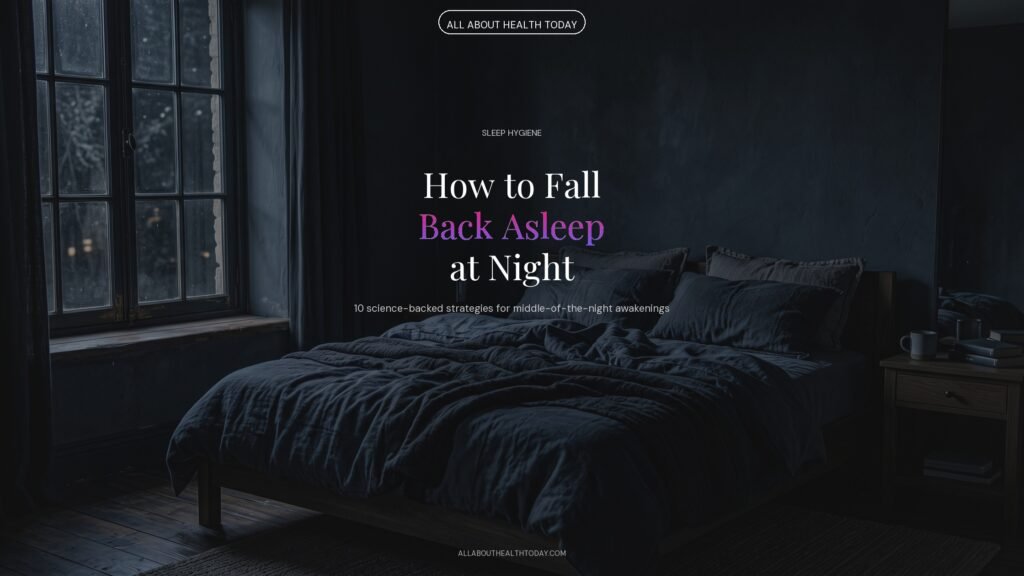
The good news? There are specific, science-backed strategies for learning how to fall back asleep after waking up at night — techniques that don’t rely on medication and that actually retrain your brain over time. Here are ten of them, from immediate breathing exercises to long-term behavioral shifts.
1. Don’t Check the Clock
It’s the most automatic impulse in the world: roll over, squint at the nightstand, calculate exactly how much sleep you’re missing. And it’s also one of the worst things you can do.
Clock-watching triggers a cascade of stress responses. When you see that it’s 2:45 a.m. and do the mental math — “I’ve only slept four hours, I have a big meeting tomorrow” — your amygdala fires up, cortisol surges, and your heart rate ticks upward. Your brain shifts from sleepy to vigilant in seconds. Suddenly, falling back asleep isn’t just a biological process — it becomes a performance you’re failing at, and that anxiety is itself the obstacle.
The fix is simple but requires discipline: turn your clock away from the bed, or better yet, remove it entirely from your line of sight. If you use your phone as an alarm, place it face-down across the room. That way, if you do need to check the time, you’ll have to physically get up — a behavioral speed bump that gives you a moment to reconsider. Some sleep specialists go further and recommend covering all glowing electronics in the bedroom, including cable boxes and chargers, so there’s no temptation to glance at anything.
What you don’t know really can’t hurt you in this case. Your body is better at self-regulating sleep pressure than your conscious mind is.
2. Get Out of Bed After 15–20 Minutes
This one feels counterintuitive — isn’t the goal to stay in bed? — but it’s one of the most effective techniques in sleep psychology, grounded in a method called stimulus control therapy.
Here’s the principle: your brain is an association machine. Every time you lie in bed wide awake, frustrated and stressed, you’re training it to associate your bed with wakefulness and anxiety rather than sleep. Over weeks and months, the bed itself becomes a trigger for alertness. The longer you lie there, the stronger that link grows.
The protocol is straightforward: if you’ve been awake for roughly 15 to 20 minutes, get up. Don’t watch the clock to time it precisely (see Tip #1) — just estimate. Go to another room. Keep the lights as dim as possible — a small nightlight or hallway light is sufficient. Do something calm and mildly boring: read a physical book, fold laundry, listen to a slow podcast, or practice some of the breathing techniques below. Do not turn on the TV, check your phone, or start working.
Return to bed only when you feel genuinely drowsy — not just tired of being out of bed, but actually heavy-eyed and ready to sleep. If you lie back down and still can’t drift off after another 15–20 minutes, get up again. It can feel tedious at first, but over time, this technique breaks the bed-wakefulness loop and rebuilds the bed as a reliable cue for deep, restorative sleep.
3. Practice the 4-7-8 Breathing Technique
Developed by Dr. Andrew Weil, the 4-7-8 breathing method is one of the most accessible tools for activating your parasympathetic nervous system — the branch of your autonomic nervous system responsible for “rest and digest,” as opposed to “fight or flight.”
Here’s how it works:
- Inhale quietly through your nose for 4 seconds.
- Hold your breath for 7 seconds.
- Exhale completely through your mouth, making a whoosh sound, for 8 seconds.
- Repeat for a total of four breath cycles.
The extended exhale is the key. When you breathe out slowly, you stimulate the vagus nerve, which signals your heart to slow down and your blood pressure to drop. The forced hold also builds up carbon dioxide slightly, which has a natural sedating effect on the nervous system — the same mechanism that makes a paper bag helpful during a panic attack, though far gentler.
Do this right in bed. You don’t need to sit up, you don’t need props, and you don’t need to make any noise loud enough to wake a partner. Four cycles takes roughly two minutes, and many people find that by the third or fourth cycle, their mind has shifted away from racing thoughts and toward the rhythm of the breath itself. It’s a physiological override button — and you can press it any time.
4. Try Progressive Muscle Relaxation (PMR)
Progressive Muscle Relaxation is an evidence-based technique developed by American physician Edmund Jacobson in the 1920s, and it remains a mainstay of behavioral sleep medicine today. The logic is elegant: physical tension often mirrors mental tension, and by releasing one, you can signal safety to the other.
Here’s the practice:
- Lie on your back with your eyes closed.
- Starting with your feet, curl your toes tightly and tense the muscles of your feet for about 5 seconds. Then release, noticing the sensation of relaxation that follows.
- Move up to your calves, tensing for 5 seconds, then releasing.
- Continue this pattern — thighs, glutes, abdomen, hands, arms, shoulders, neck, and finally face (scrunch your eyes, clench your jaw, then let everything go).
- After you’ve worked through your entire body, take a few slow breaths and notice the overall feeling of heaviness and calm.
What makes PMR particularly effective for middle-of-the-night awakenings is that it gives your brain a non-cognitive task. You’re not ruminating on tomorrow’s to-do list or replaying an awkward conversation — you’re methodically working through muscle groups. It occupies the same mental bandwidth that anxiety would otherwise consume, and the physical release that follows each contraction reinforces a sensation of letting go that often carries into sleep.
5. Keep the Room Cool, Dark, and Quiet
Environmental factors can make or break your ability to stay asleep through the night — and to fall back asleep if you do wake up. Your body’s core temperature needs to drop by about 1–2°F (roughly 0.5–1°C) to initiate and maintain sleep, which is why the optimal bedroom temperature for sleep is 65–68°F (18–20°C).
A room that’s too warm disrupts this thermoregulation. You might not even feel consciously hot, but your body will struggle to enter and sustain the deeper stages of sleep. If you’re prone to waking up, try setting your thermostat lower than you think you need — you can always add a blanket, but cooling an already-warm body is physiologically harder.
Light is equally critical. Even small sources of ambient light — a streetlamp through the curtains, a charging indicator LED, the glow of a digital clock — can suppress melatonin and fragment sleep. Blackout curtains are a worthwhile investment, and a comfortable sleep mask is a cheap, travel-friendly alternative that works for any bedroom.
As for sound, the goal isn’t necessarily total silence. Many people find that a white noise machine or a steady fan helps mask the irregular sounds that tend to trigger micro-arousals — a car door slamming outside, a creak in the house, a partner’s snoring. The key is consistency: your brain habituates to steady background noise and filters it out, while unpredictable sounds jolt you toward wakefulness. White noise machines can be especially effective at smoothing over these disruptions.
6. Avoid Screens and Blue Light
You already know that screens before bed are bad for sleep. But the 3 a.m. temptation is arguably more dangerous — because at that hour, you’re desperate, and the phone feels like a harmless companion. It’s not.
Blue light — the wavelength emitted by phones, tablets, laptops, and most LED screens — directly suppresses melatonin production by activating melanopsin-containing retinal ganglion cells in your eyes. These cells signal your suprachiasmatic nucleus (the brain’s master clock) that it’s daytime, regardless of what the actual clock says. A few minutes of exposure at 3 a.m. can delay your circadian rhythm enough to make falling back asleep significantly harder.
Beyond the light itself, there’s the cognitive stimulation. Opening your phone means potential exposure to emails, messages, news headlines, and social media — any of which can trigger alertness, worry, or the urge to engage. You’re not passively passing time; you’re actively jump-starting your brain at the worst possible moment.
If you absolutely must do something while you wait for sleepiness to return, reach for a physical book — ideally something mildly interesting but not gripping — and read by a dim, warm-toned lamp. Better still, a red-spectrum reading light, which has minimal impact on melatonin. But the best rule of thumb is simply: don’t touch the phone.
7. Use Cognitive Shuffling or a “Brain Dump”
Middle-of-the-night wakefulness often comes with a relentless mental companion: rumination. Your brain, freed from the distractions of the day, starts cycling through worries, plans, regrets, and hypotheticals. Each thought generates a small spike of arousal, and the spiral feeds itself.
Two distinct strategies can help:
Cognitive shuffling — developed by cognitive scientist Luc Beaudoin — is a technique where you deliberately think of random, unrelated objects or words in sequence. For example: “apple… giraffe… envelope… bicycle… waterfall…” The randomness prevents your brain from locking onto any single thought long enough to generate anxiety, while the mild cognitive effort mimics the kind of fragmented, non-linear thinking that naturally precedes sleep. It essentially tricks your brain into the pre-sleep state.
Brain dumping takes the opposite approach: instead of distracting from your thoughts, you externalize them. Keep a notebook and pen by your bed. When you wake up with a racing mind, write down everything — worries, to-dos, ideas, that thing you forgot to send. The physical act of writing has two benefits: it offloads the cognitive burden of trying to remember, and it forces vague anxieties into concrete words, which often makes them feel more manageable. Close the notebook and leave it on the nightstand — the problems will be there in the morning. Right now, your only job is sleep.
8. Avoid Checking Your Phone (Even Beyond Blue Light)
Tip #6 covered blue light, but the phone problem goes deeper than that. Even if you’ve enabled every night mode, warm-shift filter, and grayscale setting available, your phone is still a gateway to cognitive activation.
Think about what your phone represents to your brain: it’s the device you use to solve problems, communicate, consume information, and stay vigilant. Every notification badge, every unread count, every headline is a potential micro-stressor. At 3 a.m., your prefrontal cortex — the rational, impulse-controlling part of your brain — is running at reduced capacity. That means you’re less equipped to resist the pull of “just quickly checking,” and more likely to stumble into something that triggers a stress response.
The very act of picking up the phone engages your motor system, your visual system, and your attention — all of which signal wakefulness to your body. And because phones are variable reward machines (you never know what you’ll find — a boring email or an urgent message), they tap into dopamine pathways that reinforce checking behavior over time.
The solution is structural, not willpower-based. Charge your phone in another room, or at minimum, across the bedroom where you can’t reach it from the bed. Use a dedicated alarm clock if you need one. Make the default path — doing nothing — the path of least resistance.
9. Try a Body Scan Meditation
Body scan meditation is a mindfulness practice that sits at the intersection of progressive muscle relaxation and cognitive shuffling — and it’s particularly well-suited to the middle of the night, when you’re already lying down and the conditions are right for introspection.
Here’s the practice:
- Close your eyes and bring your attention to the top of your head.
- Slowly move your awareness downward — scalp, forehead, eyes, jaw, neck — noticing any sensations you encounter. Tightness, warmth, tingling, discomfort, or simply the feeling of your skin against the pillow. Don’t try to change anything; just notice without judgment.
- Continue down through your shoulders, arms, hands, chest, abdomen, back, hips, legs, and feet.
- If your mind wanders — and it will — gently bring it back to the part of the body you were scanning, without frustration. The act of noticing you’ve wandered and returning is the practice.
Research on mindfulness-based interventions for insomnia shows that body scan meditation reduces cortisol levels and increases activity in brain regions associated with interoceptive awareness — your ability to sense what’s happening inside your body. That matters because people with insomnia tend to have an overactive stress-response system and an underactive body-awareness system. The body scan rebalances both.
It also has the advantage of being infinitely scalable. You can do a full 20-minute scan on a bad night, or a quick 3-minute version when you just need a nudge back toward sleep. Either way, you’re training your brain to inhabit your body rather than race ahead of it.
10. Know When to Seek Professional Help
These strategies are effective for the majority of people who experience occasional nighttime awakenings. But it’s important to recognize when a problem crosses the threshold from “annoying” to “clinical.”
The guideline used by sleep specialists is straightforward: if you’re waking up during the night three or more times per week, and this has persisted for longer than three months, you may be dealing with chronic sleep-maintenance insomnia. At that point, lifestyle tweaks alone may not be sufficient — and that’s not a failure on your part; it’s a signal that your sleep system needs more structured intervention.
The gold standard treatment for chronic insomnia is Cognitive Behavioral Therapy for Insomnia, or CBT-I. Unlike sleeping pills, which address symptoms temporarily and can create dependency, CBT-I targets the underlying behaviors and thought patterns that perpetuate insomnia. It typically combines several of the techniques described above — stimulus control, sleep restriction, cognitive restructuring, and relaxation training — into a structured 6–8 week program delivered by a trained therapist or through digital platforms like Sleepio or SHUTi, which have been validated in clinical trials.
Consider also consulting your primary care physician if your nighttime awakenings are accompanied by other symptoms: loud snoring and gasping (possible sleep apnea), restless legs, night sweats, or persistent pain. Some causes of sleep-maintenance insomnia — like sleep apnea or periodic limb movement disorder — are physiological and require medical diagnosis.
Above all, don’t suffer in silence. Chronic poor sleep is linked to cardiovascular disease, metabolic dysfunction, depression, and cognitive decline. It’s not a character flaw or a sign of weakness — it’s a medical issue, and effective treatments exist. Your overall sleep quality is worth advocating for.
Understanding Why You Wake Up
To apply these techniques effectively, it helps to understand what’s happening in your brain and body when you wake up in the middle of the night. Sleep architecture is the structure of your night’s sleep — the cycling between light sleep, deep sleep, and REM (rapid eye movement) sleep.
A typical adult cycles through these stages roughly every 90 minutes. Brief awakenings — often at the transitions between cycles — are entirely normal. In fact, most people wake up several times per night; they just don’t remember it because the awakenings are so brief that they don’t register in conscious memory.
The problem arises when something prevents you from sliding back into the next cycle. Common culprits include:
- Stress and anxiety: Elevated cortisol levels reduce sleep pressure and promote vigilance.
- Alcohol: While it helps you fall asleep faster, alcohol fragments sleep in the second half of the night as your body metabolizes it.
- Caffeine: With a half-life of 5–6 hours, a 3 p.m. coffee can still be active in your system at midnight.
- Blood sugar fluctuations: A late-night blood sugar crash can trigger a cortisol release that wakes you up.
- Nocturia: Waking to urinate, which can be caused by nighttime fluid intake, prostate issues, or untreated sleep apnea.
- Environmental disruptions: Noise, light, temperature shifts, or a restless bed partner.
Addressing the root cause — not just the symptom — is the most sustainable path forward. If you consistently wake up at the same time, consider what might be happening 30–60 minutes before that moment, and experiment with the best ways to improve your sleep holistically.
Putting It All Together
No single technique on this list is a magic bullet. The science of sleep is clear: consistency and patience matter more than any one intervention. Start with one or two techniques that resonate with you — perhaps the 4-7-8 breathing and turning the clock around — and practice them for at least two weeks before adding others.
If you find yourself awake at 3 a.m. tonight, try this sequence: (1) don’t open your eyes or check the time, (2) take four cycles of 4-7-8 breathing, (3) if you’re still awake after what feels like 15 minutes, get up and do something boring in dim light, (4) return to bed when drowsy and try a body scan. No phone, no clock, no self-criticism.
The goal isn’t to obliterate nighttime awakenings entirely — they’re a normal part of human sleep. The goal is to teach your brain that waking up is safe, boring, and temporary — not a crisis to be managed, but a few quiet moments in the dark that will pass.
If you’d like deeper insight into your night, a non-wearable sleep tracking mat can show you what’s happening under the surface — no wristband required.
Reviewed by Dr. A. Collins, MD — Board Certified Internist