

The Blueair Blue Pure 411a Max is a genuinely good small-room purifier with a verified CADR of 300. The listing quotes 465 square feet, but that assumes 4.8 air changes an hour. Run it harder, as allergy season demands, and the honest coverage is closer to 232 square feet. Here is the maths, the trial evidence, and who should actually buy it.
- CADR
- 300 smoke, dust and pollen
- Room size
- 465 sq ft at 4.8 ACH
- Room size
- 232 sq ft at ~9.7 ACH
- Noise
- 11–50 dB low to high
- Ozone
- CARB certified zero ozone
- Filtration
- HEPASilent mechanical + electrostatic
What the Blue Pure 411a Max actually is
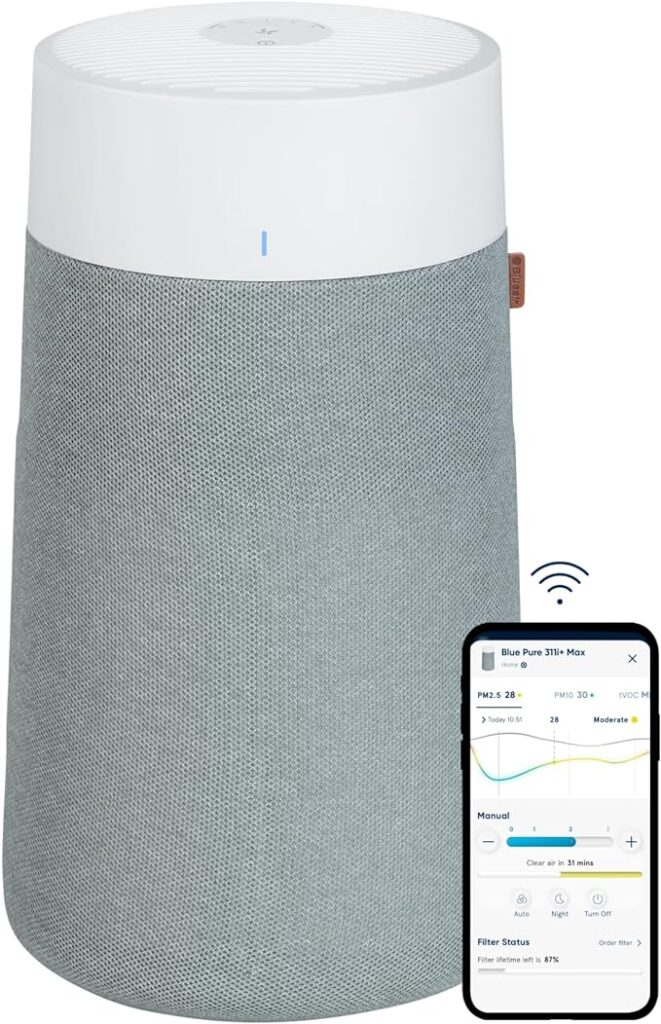
Blueair’s 411a Max is a compact portable purifier aimed at bedrooms and small rooms. It uses the company’s HEPASilent design, which pairs a mechanical filter with an electrostatic charge to trap particles, a combination that lets it move a lot of air with relatively little noise. That trade-off is the whole point of this unit.
The single most useful number on the box is CADR: clean air delivery rate, measured in cubic feet per minute of filtered air for smoke, dust and pollen. This model is rated at 300. Everything else — room size, suitability, noise — follows from that number and from how hard you run the fan.
What it is not
It is not a whole-home solution, an odour-removal machine or a substitute for fixing damp, ventilation or a pet you are allergic to. Portable purifiers reduce what is suspended in the air of one room. They do not clean surfaces, and settled dust is exactly what gets disturbed when you walk in.
The spec sheet, and what each number means for you
| Spec | Value | What it means in practice |
|---|---|---|
| CADR | 300 cfm | The ceiling on everything else. Higher CADR means more filtered air per minute, or the same filtration more quietly. |
| Room size at 4.8 ACH | 465 sq ft | The number on the marketing page. Reasonable for general dust and odour in a closed room. |
| Room size at ~9.7 ACH | 232 sq ft | The number to use for allergies, asthma or smoke, where faster turnover matters more. |
| Noise | 11–50 dB | 11 dB is effectively silent — the low setting is genuinely sleep-friendly, which matters more than most specs if you struggle at night, as covered in our guide to sleep quality tips. 50 dB on high is normal conversation volume. |
| Ozone | CARB certified, zero ozone | No ozone-generating technology. This matters if you have asthma or react to scented devices. |
| Filtration | HEPASilent | Mechanical plus electrostatic. Effective, but see the wildfire smoke caveat below on filter degradation. |
Note the two room sizes. They are not a contradiction, they are the same machine under different assumptions, and which one applies depends on what you are trying to achieve.
The air-change maths: why “465 square feet” is not the number to trust
Air changes per hour, or ACH, is how many times the purifier moves the full volume of the room through its filter in an hour. The relationship is simple arithmetic, and once you know it you can evaluate any purifier on any room.
Run the numbers on a CADR of 300 and both quoted figures fall out of the same equation. At 4.8 ACH you get roughly 465 square feet. At 232 square feet the same machine is delivering close to 9.7 air changes an hour. Both are true; they describe different intensities of use.
| Air changes per hour | Room size for CADR 300 | What this level is for |
|---|---|---|
| 2 ACH | ~1,115 sq ft | Bare minimum turnover. Not enough for allergy claims. |
| 4.8 ACH | ~465 sq ft | General indoor air quality, dust and odour reduction. |
| ~9.7 ACH | ~232 sq ft | Allergen and smoke periods, bedrooms, closed doors. |
| 12+ ACH | ~187 sq ft | Wildfire smoke or someone isolating in one room. |
How to size it for your own room
- Measure the floor area and the ceiling height. Multiply them to get cubic feet. An 8-foot ceiling is a safe default.
- Pick your target ACH. 5 for ordinary use, 8 to 10 if there is an allergy, asthma or a smoky season.
- Work backwards to the CADR you need. Required CADR = (ACH × volume) ÷ 60.
- Compare that figure to the box. If the purifier’s CADR is lower, it will run on high and never catch up.
- Assume a closed room. An open door halves your effective number.
For a 200-square-foot bedroom with 8-foot ceilings and a target of 9 ACH, you need about 240 CADR. This unit has 300, so it fits with a little headroom and will not spend its life on the loud setting. For a 500-square-foot open-plan living space, you need around 600 — which is why this model is the wrong purchase for that room.
What the trial evidence actually supports Grade B
Air purifiers sit in an awkward evidence zone: the physics is solid, the clinical outcomes are messier. Filtration reliably lowers indoor particulate levels. Whether that translates into fewer symptoms depends on the disease, the room and how the device is used.
Asthma
A 2026 randomised controlled trial assigned 100 adults with moderate-to-severe asthma to HEPA H14 air cleaners or placebo and followed them for eight months, measuring indoor PM2.5 and PM10 alongside Asthma Control Test scores and lung function. That is the right design for the question, and it is one of the larger trials in this space. The broader literature has been slower to deliver clear clinical wins than the marketing implies.
Allergic rhinitis
A multicentre, randomised, double-blind, placebo-controlled trial placed active or mock purifiers in the living room and bedroom of adults with house dust mite-induced allergic rhinitis and ran them for six weeks. Two units, two rooms, real households — this is how the devices are actually used, and it is the study design that matters when you are deciding whether one unit in one bedroom is enough. If you want a sense of how much of this is environmental, our piece on seasonal allergies and natural remedies covers the rest of the picture.
Cat and pet allergen
A randomised, double-blind trial in 30 patients with mild cat asthma used an exposure chamber and a HEPA H13 unit against 80 ng/m³ of cat allergen. Chamber studies control the exposure, which makes them clean tests of filtration — and also means the real-world gain depends on how much allergen is being generated in your home in the first place.
Ozone reaction products
An often-missed benefit: when ozone gets indoors it reacts with household chemicals to form products that can carry into the deep lung. An intervention study of 84 participants, 50 with HEPA filtration and 34 controls, tested whether filtration mitigates those cardiorespiratory effects. This is a different mechanism from pollen, and it is one reason a mechanical filter beats a scent-masking device.
Where this unit falls short
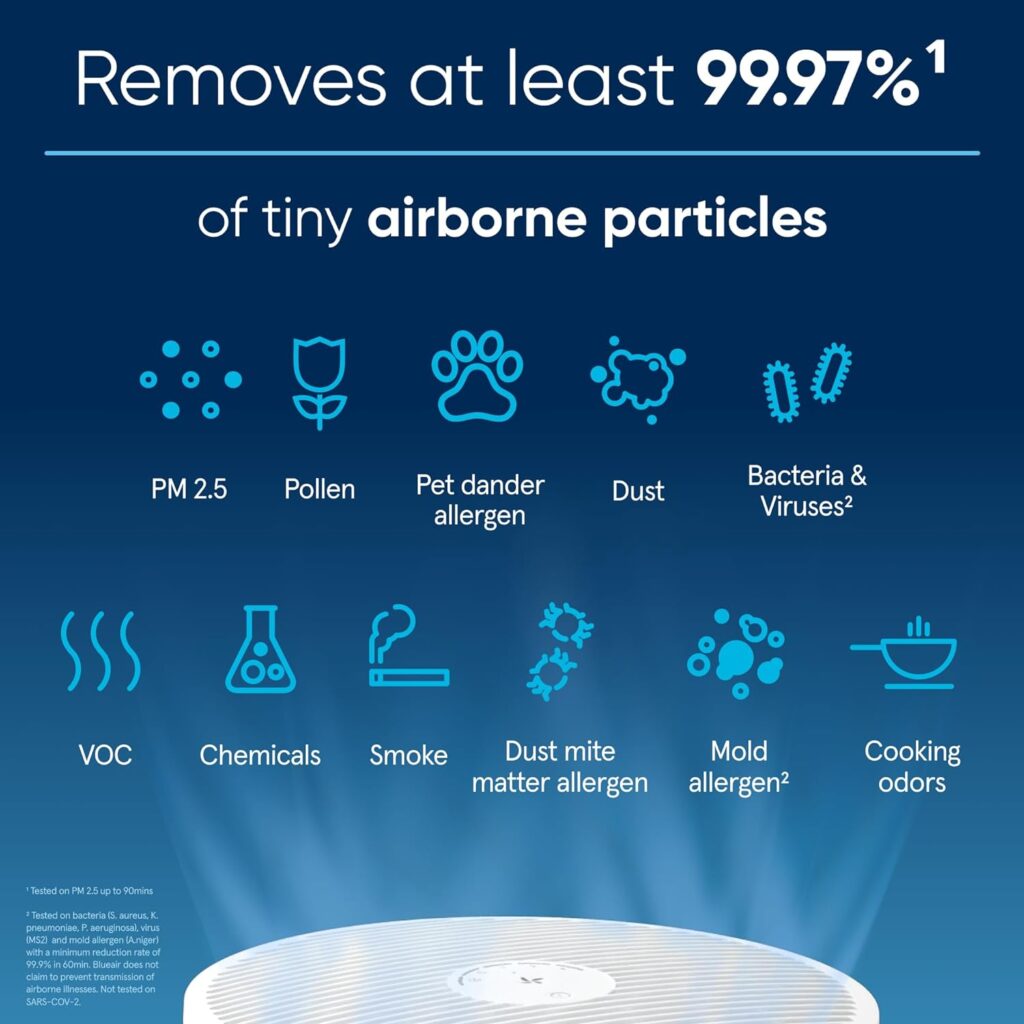
Four limitations worth knowing before you buy, none of which appear in the product photography.
- The coverage claim needs halving for allergy use. 465 square feet is a 4.8 ACH number. If you want 9 to 10 air changes during pollen season, you are covered for about 232 square feet.
- High fan is loud. The 11 dB low setting is the reason to buy this unit, and it is worth understanding how noise fits into sleep architecture before you compromise on it. The 50 dB high setting is the reason to size it correctly, because a purifier that must run on high to keep up is a purifier you will eventually switch off.
- Electrostatic filters degrade faster than they look. Research on electret HVAC filters under wildfire smoke found efficiency can collapse at particle loadings well below the point where airflow resistance rises. Translation: a filter that looks fine and still fits can already be underperforming.
- It cleans one room. Air is not contained by walls the way marketing implies. Doors, draughts and open-plan layouts all dilute the effect.
If you have a larger space, our review of the Levoit Core 300 covers the budget alternative, and the respiratory health overview puts filtration in context with the other things that matter.
Who should buy it, and who should not
| Situation | Verdict | Why |
|---|---|---|
| Bedroom up to ~230 sq ft | Buy it | Correctly sized, and the low setting is quiet enough to sleep through. |
| Allergic rhinitis or mild asthma, one room | Buy it | Enough turnover at the 232 sq ft figure, with a clean ozone profile. |
| Pet in a small apartment | Reasonable | Helps airborne allergen, does nothing for surfaces or grooming. |
| Open-plan living space over 400 sq ft | Skip it | You need roughly double the CADR. Two units or a larger model. |
| Wildfire smoke season | Buy with care | Works, but check the filter far more often than the recommended interval. |
| Odour or chemical sensitivity | Skip it | Particle filtration is not gas filtration. You need carbon, and a lot of it. |
Filters and running costs: the number people forget
A purifier is a subscription with a hardware deposit. The purchase price is the small number.
Rather than quote a price that will change, do the arithmetic once: filter price divided by replacement interval gives your true monthly cost, and adding electricity gives the running total. A unit that costs less up front and takes a cheap filter every six months often beats a discounted unit with an expensive proprietary filter.
- Replace on schedule, not on appearance. As above, electrostatic media can lose efficiency before airflow drops.
- Replace sooner in smoke season. Wildfire particulate loads a filter far faster than ordinary household dust.
- Vacuum the pre-filter monthly. It is the cheapest maintenance you will ever do and it extends the main filter.
- Do not run it in a room with the window open. You are filtering the neighbourhood.
Where to put it (this matters more than the brand)
Placement changes real-world performance more than most spec differences between models. The same purifier can be a useful device or an expensive fan depending on where it sits.
- Put it where you are, not where it looks good. Bedroom or the room you spend the evening in. Filtering an empty hallway is a hobby.
- Two to three feet off the floor, clear of furniture. Purifiers pull air in from the sides. A unit pushed into a corner or jammed behind a sofa is working against itself.
- Aim the outflow along the room, not into a wall. Good circulation is what turns a local device into a room device.
- Keep it away from the bed’s head end if you can. Air movement close to the face is the most common reason people stop using a purifier overnight.
- Close the door. An open door to a hallway doubles the volume it is trying to clean and halves the air changes you actually get.
One more thing worth saying plainly: source control beats filtration every time. A damp carpet, an unvented bathroom or a mattress older than your relationship will out-produce any purifier. Fix the source, then filter what is left.
Verdict
The Blue Pure 411a Max does one job well: quiet, effective particle filtration for a small room. The CADR of 300 is honest, the ozone certification is a real plus for anyone with airway disease, and the low-fan noise level is the best thing about it.
What it is not is a 465-square-foot allergy solution. Size it to about 230 square feet for that use, or accept that it will live on the loud setting. Buy it for a bedroom, not a living room, and budget for filters from day one.
Verdict: excellent small-room purifier, oversold room size
If your room fits the realistic number, this is one of the better quiet purifiers at the price. If you bought it expecting to cover an open-plan space, you will be disappointed by physics rather than by the product.
Frequently asked questions
What room size does the Blueair 411a Max actually cover?
About 465 square feet at 4.8 air changes an hour, which is the marketing figure. For allergy or smoke use at roughly 9.7 ACH, treat it as a 232-square-foot unit.
Is it quiet enough to sleep with?
Yes on the low setting, which is rated at 11 dB — quieter than a whisper. If you use sound to sleep, see our comparison of white noise machines to avoid stacking two devices. The high setting reaches 50 dB, so if your room is too large for the unit you will be sleeping next to a conversation.
Does it produce ozone?
No. It is CARB certified with zero ozone, which distinguishes it from some ionising and UV purifiers. That matters if you have asthma.
How often should the filter be replaced?
Follow the manufacturer’s interval as a baseline and shorten it during wildfire smoke or heavy pollen. Efficiency can drop before airflow does, so appearance is a poor guide.
Will it help with allergies?
It reduces airborne particles and allergen in the room it serves, and trials in allergic rhinitis and cat allergy support that mechanism. It will not compensate for a pet on the bed or a damp carpet.
One purifier or two for an apartment?
Two small units in the rooms you actually occupy usually beat one large unit in a hallway. Air does not distribute itself the way floor plans suggest.
Sources
- Li L, et al. Indoor environmental health and asthma relief: findings from a longitudinal HEPA filter trial. J Environ Sci Health A, 2026. PMID 41979079
- Park KH, et al. Effects of air purifiers on patients with allergic rhinitis: a multicenter, randomized, double-blind, placebo-controlled study. Yonsei Med J, 2020. PMID 32734732
- Gherasim A, et al. Efficacy of air cleaners to reduce allergic responses to cat: a randomized clinical trial using an environmental exposure chamber. Respir Med, 2025. PMID 40246248
- He L, et al. Indoor HEPA filtration mitigates adverse cardiorespiratory effects of ozone reaction products. Environ Sci Technol, 2026. PMID 42054299
- Mudgal SK, et al. Effectiveness of personal-level protective measures against air pollution on respiratory health: a systematic review and meta-analysis. Indian J Occup Environ Med, 2026. PMID 41970007
- Ebrahimifakhar A, et al. A systematic review and meta-analysis of field studies of portable air cleaners: performance, user behavior, and by-products. Sci Total Environ, 2024. PMID 38008326
- Wang S, et al. Charge-driven degradation of residential electret HVAC filters under wildfire smoke exposure. Environ Sci Technol, 2026. PMID 42916414