

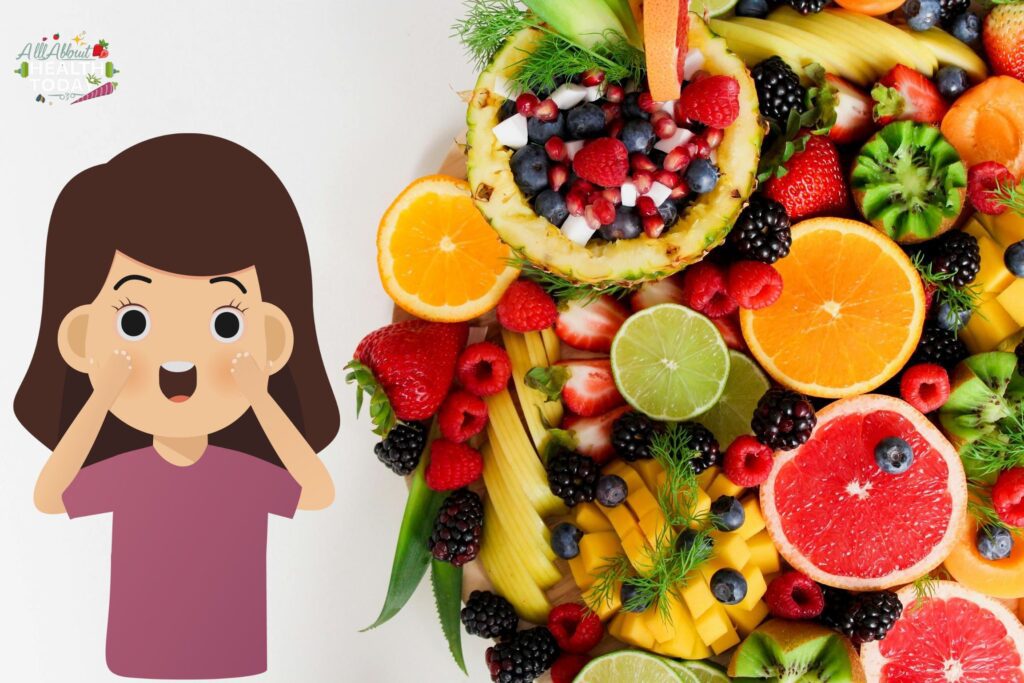
Eat fruit daily because whole fruit consistently tracks with lower cardiovascular risk, lower all-cause mortality and no increase in type 2 diabetes risk. The sugar it contains arrives inside fibre and water, which changes how fast it is absorbed. The one form that reliably behaves badly is juice.
Medically reviewed by Dr. A. Collins, MDBoard Certified Internist · Updated 26 October 2026
Why the sugar in fruit behaves differently

Fruit contains glucose, fructose and sucrose — the same molecules found in a can of cola. What differs is the delivery. In whole fruit those sugars sit inside plant cell walls, alongside fibre, water and micronutrients. Your digestive system has to break the walls down, which takes time, so the sugar arrives at the bloodstream gradually rather than in one surge.
That single difference explains most of what follows. When researchers measured how whole fruit versus fruit juice affects diabetes risk across large cohorts, the two moved in opposite directions (Muraki, 2013). Same fruit, different packaging, different result.
Fibre is the mechanism with the best evidence behind it. Higher fibre intake is associated with lower cardiovascular risk in pooled cohort analyses (Threapleton, 2013), and carbohydrate quality — whether the fibre is still attached — tracks with health outcomes more strongly than carbohydrate quantity (Reynolds, 2019).
Myth: fruit sugar is basically added sugar
The claim “Fruit is full of sugar, so it is no better than sweets.”
The reality The molecules are similar. The package is not. A whole apple brings fibre, water, vitamin C, potassium and polyphenols that a boiled sweet does not, and it requires chewing, which measurably affects satiety. Studies that link sugar to harm are overwhelmingly studies of added sugar and sugar-sweetened drinks, not whole fruit.
Verdict: false, and it confuses two different exposures
Myth: fructose damages the liver
The claim “Fructose is a liver toxin, so fruit is damaging your liver.”
The reality The liver does metabolise fructose, and very large doses of free fructose can drive fat synthesis. But the doses used to demonstrate that are far above what whole fruit delivers. Getting to those intakes from apples would require eating an implausible quantity; from sweetened drinks it takes about a minute. The distinction is dose and delivery, not the molecule.
Verdict: overstated — true for large free-fructose loads, not for whole fruit
Myth: fruit makes you gain weight
The claim “Fruit is high in sugar, and sugar makes you fat.”
The reality Fruit is one of the least energy-dense, most satiating food groups available, because water and fibre dilute the calories and chewing slows the rate at which you eat. Higher fruit and vegetable intake is associated with lower all-cause mortality in large pooled analyses (Wang, 2014). Dried fruit is the exception on energy density, not on health.
Verdict: false for whole fruit
Myth: type 2 diabetes means giving up fruit
The claim “If you have diabetes, fruit will spike your blood sugar.”
The reality Whole fruit intake is not associated with increased type 2 diabetes risk, and specific fruits — blueberries, grapes, apples — are associated with lower risk in prospective cohorts (Muraki, 2013). For people who already have diabetes, fruit eaten with protein or fat produces a flatter response than fruit eaten alone. Portion and pairing matter; elimination does not help.
Verdict: false — and eliminating fruit removes fibre that helps
Myth: a glass of juice is a serving of fruit
The claim “Juice is fruit, so it counts the same.”
The reality This is the one where the sceptics are right. Juice keeps the sugar and discards most of the fibre and all of the chewing. In pooled cohort analyses, fruit juice consumption is associated with higher type 2 diabetes incidence, while whole fruit is not (Imamura, 2015). A glass of orange juice takes seconds to drink and delivers the sugar of several oranges. The same pattern appears in analyses of sugar-sweetened and artificially sweetened beverages and their metabolic outcomes (Qin, 2020).
Verdict: true — juice does not substitute for whole fruit
Myth: dried fruit is just candy
The claim “Dried fruit is confectionery with a health halo.”
The reality Dried fruit retains fibre and micronutrients; what it loses is water, which concentrates both sugar and calories into a small volume. It is not candy, but it is easy to eat a large amount quickly because the volume cue has gone. A small handful is a sensible portion; the whole bag is not.
Verdict: mostly false — with a real portion caveat
What you actually get from each form
The practical comparison, without inventing numbers, is about what survives processing. Chewing, fibre and volume are the three things that make whole fruit behave well, and each form loses a different amount of them.
Whole fruit
- Fibre: intact
- Chewing: required
- Volume cue: strong
- Sugar delivery: slow
The reference form. Everything else is measured against it.
Frozen fruit
- Fibre: intact
- Chewing: required
- Volume cue: strong
- Sugar delivery: slow
Nutritionally equivalent to fresh, and often cheaper out of season.
Dried fruit
- Fibre: mostly retained
- Chewing: some
- Volume cue: weak — water removed
- Sugar delivery: moderate to fast
Good food, small portion. The water loss is the whole story.
Juice
- Fibre: mostly removed
- Chewing: none
- Volume cue: almost none
- Sugar delivery: fast
Behaves like a sweetened drink. Treat it as one.
If you want the deeper physiology, the reason these differences matter is the speed of glucose delivery, covered in how carbohydrates power the body and in hidden blood sugar spikes. The specific fructose question is covered in fruit sugar versus added sugar.
What the population evidence actually shows
Pooled analyses of prospective cohorts are the strongest evidence available here, because no one is randomising people to eat fruit for twenty years. The direction is consistent across them.
- Cardiovascular disease and mortality. Higher fruit and vegetable intake is inversely associated with cardiovascular disease, total cancer and all-cause mortality, with the largest benefit appearing up to roughly 800 g a day (Aune, 2017).
- Dose response. Each additional portion is associated with a further reduction in mortality risk, in a pattern that flattens rather than reversing (Wang, 2014).
- Diabetes. Whole fruit is neutral to protective; juice is the opposite (Muraki, 2013), (Imamura, 2015).
- Fibre as the mediator. The cardiovascular signal is partly explained by fibre, which is exactly what processing removes (Threapleton, 2013).
- Glycaemic patterns. Dietary patterns built on lower glycaemic index and load improve glycaemic control in clinical trials (Chiavaroli, 2021), which is a reason to build meals around fruit rather than around juice and refined starch.
What this evidence cannot do is separate fruit from the kind of person who eats fruit. People who eat more fruit also tend to exercise, smoke less and earn more. The effect sizes survive adjustment for those factors, but residual confounding never disappears entirely in observational data.
How much, and does the type matter
Two to three portions a day is a reasonable target and roughly matches the intake at which the mortality curves flatten. A portion is about 80 g: a medium apple, a handful of berries, two small plums, or a couple of tablespoons of dried fruit.
- Variety beats optimisation. Different fruits carry different polyphenols and fibre types. Rotating colours and types is more useful than hunting for a single best fruit.
- Eat the skin where you can. Much of the fibre and a large share of the polyphenols sit in or just under it.
- Pair with protein or fat if you have glucose concerns. Fruit with yoghurt, nuts or cheese produces a flatter curve than fruit alone.
- Keep juice small and occasional. If you drink it, treat it as a dessert rather than a hydration strategy.
- Whole fruit first, supplements never. There is no evidence that a fruit-extract capsule substitutes for eating fruit.
Fruit also sits naturally inside the dietary patterns with the best outcome data: the Mediterranean pattern, the heart-healthy pattern, and the anti-inflammatory approach set out in anti-inflammatory foods. For the nutrient side, see the best fruits for antioxidants and vitamins for energy.
Two related questions worth reading next: whether sugar is genuinely addictive in the sugar addiction question, and how fruit fits a low-carbohydrate approach in blood sugar dysregulation. If you are watching potassium for kidney reasons, the fruit list changes — see the kidney diet guide. Feeding the gut is a separate benefit, covered in the fermented foods guide.
Fruit, fibre and the gut
Half of the case for fruit is not about vitamins at all. It is about what the fibre does once it reaches the colon, where bacteria ferment it into short-chain fatty acids. Those compounds feed the cells lining the gut and influence glucose handling and appetite signalling, which is why fibre intake tracks with metabolic outcomes rather than merely with regularity.
Different fruits deliver different fibre types, and that is an argument for variety rather than for a single optimal fruit. Berries carry a mix of soluble fibre and polyphenols; apples and pears are high in pectin; bananas supply resistant starch when slightly under-ripe. Rotating them gives the gut population more substrates than eating the same fruit every day.
The broader relationship between fermented fibre, gut bacteria and metabolic health is covered in the fermented foods guide, and the specific case of bacterial overgrowth in SIBO explained. Fruit is a modest contributor to that picture; it is not a treatment for it.
Fruit on a low-carbohydrate diet
People who reduce carbohydrate often cut fruit first, on the assumption that it is the sugary option. That is a reasonable instinct and an incomplete one. The fruits with the lowest carbohydrate density per portion — berries, melon, kiwi — fit comfortably into most low-carbohydrate patterns, and they bring fibre that a diet of meat and cheese does not.
The trade-off is real but narrower than it looks. A portion of berries contains roughly a third of the carbohydrate of a banana, so choosing the lower-density fruits lets you keep the fibre and polyphenols without spending much of a daily carbohydrate budget. The approach that eliminates fruit entirely is usually eliminating the fibre with it.
Where a very low-carbohydrate or ketogenic approach is genuinely indicated — and it can be, particularly in type 2 diabetes — the trade-off is different and the guidance in the ketogenic diet guide is the relevant one. What is not supported is the general claim that fruit is harmful for everyone on a reduced-carbohydrate diet.
Blood glucose responses vary substantially between individuals eating identical meals, so the honest advice for anyone monitoring glucose is to test their own response to a given fruit rather than to accept a general rule. The variability is documented in blood sugar dysregulation.
Common questions about eating fruit
How much fruit should I eat a day?
Two to three portions, roughly 160 to 240 g, alongside vegetables. The mortality benefit keeps rising to around 800 g of fruit and vegetables combined, then flattens.
Is fruit bad for fatty liver?
Whole fruit is not. The fructose dose from normal fruit intake is far below what the studies showing liver fat synthesis use, and those studies use free fructose or sweetened drinks. Very high intakes of fruit juice are a different matter.
Should I avoid fruit at night?
No. Total daily intake matters far more than timing, and there is no good evidence that fruit in the evening is harmful.
Which fruits have the least sugar?
Berries, kiwi, melon and citrus are on the lower end per portion. That said, the difference between fruits is small compared with the difference between whole fruit and juice, so it is not worth optimising.
Is frozen fruit as good as fresh?
Yes. Frozen fruit is picked and frozen at ripeness, retains its fibre, and is often nutritionally equal or better than fresh fruit that has spent a week in transit.
Can fruit cause bloating?
Some people react to specific fermentable sugars in larger portions, particularly in apples, pears and stone fruit. That is an individual tolerance issue, not a reason to avoid fruit generally.
Sources
- Aune D, et al. Fruit and vegetable intake and the risk of cardiovascular disease, total cancer and all-cause mortality. Int J Epidemiol. 2017. PMID 28338764
- Wang X, et al. Fruit and vegetable consumption and mortality from all causes, cardiovascular disease, and cancer. BMJ. 2014. PMID 25073782
- Muraki I, et al. Fruit consumption and risk of type 2 diabetes: results from three prospective longitudinal cohort studies. BMJ. 2013. PMID 23990623
- Imamura F, et al. Consumption of sugar sweetened beverages, artificially sweetened beverages, and fruit juice and incidence of type 2 diabetes. BMJ. 2015. PMID 26199070
- Threapleton DE, et al. Dietary fibre intake and risk of cardiovascular disease: systematic review and meta-analysis. BMJ. 2013. PMID 24355537
- Reynolds A, et al. Carbohydrate quality and human health: a series of systematic reviews and meta-analyses. Lancet. 2019. PMID 30638909
- Chiavaroli L, et al. Effect of low glycaemic index or load dietary patterns on glycaemic control and cardiometabolic risk factors. BMJ. 2021. PMID 34348965
- Qin P, et al. Sugar and artificially sweetened beverages and risk of obesity, type 2 diabetes and hypertension. Eur J Epidemiol. 2020. PMID 32529512