
Your skin problems might not be skin problems at all.
- ✅ Your gut health directly affects your skin — it’s called the gut-skin axis
- ✅ An imbalanced microbiome can trigger acne, eczema, and psoriasis breakouts
- ✅ Key fixes: add probiotics and fiber, cut processed foods, identify food triggers
- ✅ Most people see skin improvements within 3-4 weeks of gut-focused changes
If you’ve spent hundreds of dollars on serums, creams, and dermatologist visits only to watch breakouts, flare-ups, and redness return, you may have been treating the wrong system entirely. Emerging research reveals that the root cause of many common skin conditions — from acne to eczema to psoriasis — doesn’t start on the surface. It starts in your gut.
The gut-skin axis is the bidirectional communication network between your digestive system and your skin. It’s a pathway that scientists are only beginning to fully understand, but the evidence so far is striking: an unhealthy gut microbiome can trigger inflammation, disrupt immune function, and produce skin symptoms that topical treatments simply can’t reach. For a deeper look at how the microbiome influences overall health, explore our guide to how emulsifiers and processed foods damage your microbiome.
What Is the Gut-Skin Axis?
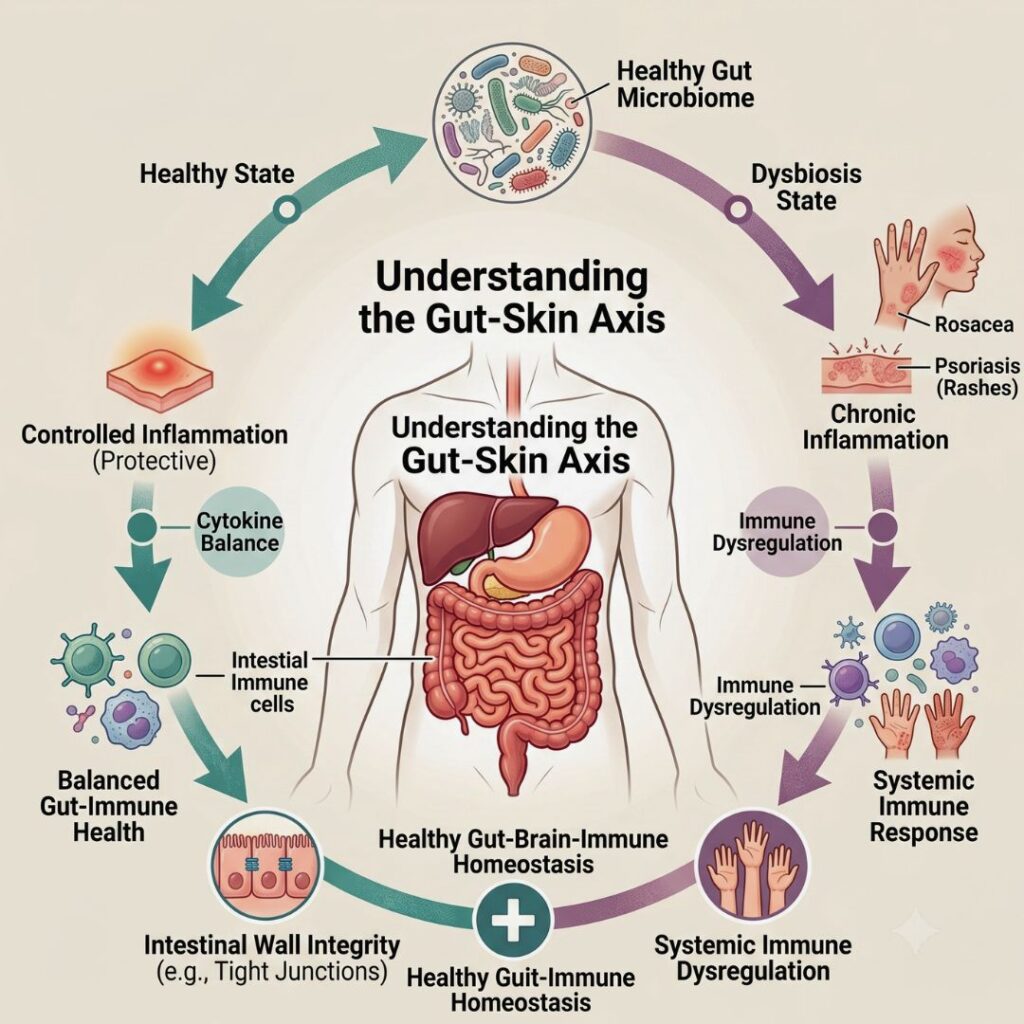
The gut-skin axis describes the complex, two-way communication between your gastrointestinal tract and your skin. This connection operates primarily through three channels: the immune system, the endocrine system (hormones), and the nervous system.
Your gut is home to trillions of microorganisms — bacteria, fungi, viruses, and other microbes — collectively known as the gut microbiome. When this ecosystem is balanced, it supports healthy digestion, robust immunity, and stable inflammation levels throughout the body. When it’s disrupted — a state called dysbiosis — the consequences extend far beyond your stomach.
Your skin, being your body’s largest organ, is uniquely sensitive to these internal shifts. Research published in PMC (2024) found that altered microbial diversity in the gut is consistently linked to inflammatory skin conditions, with the gut-skin axis acting as a primary conduit for that communication.
How Gut Health Affects Your Skin
When the gut microbiome falls out of balance, several cascading events can affect your skin directly.
Dysbiosis: An overgrowth of harmful bacteria and a decline in beneficial ones disrupts the gut lining’s barrier function. This allows bacterial byproducts and toxins to enter the bloodstream — a condition sometimes called leaky gut — triggering systemic inflammation that manifests as skin flare-ups.
Leaky gut mechanism: A compromised gut barrier means undigested food particles and toxins pass into the bloodstream. The immune system mounts a response, releasing inflammatory cytokines that travel throughout the body — including to the skin. According to a 2024 clinical review published in PMC (“From Leaky Gut to Leaky Skin”), this gut-derived inflammation is a recognized driver of atopic dermatitis and other inflammatory skin conditions.
Inflammation pathways: Chronic gut inflammation elevates cortisol and other stress hormones, which directly increase oil production in the skin and impair its barrier function — creating the perfect conditions for acne and redness.
Common Gut Issues That Cause Skin Problems
- Dysbiosis: An imbalance between beneficial and harmful gut bacteria. Linked to acne, rosacea, and premature skin aging.
- Leaky gut syndrome: Increased intestinal permeability allowing toxins into the bloodstream. Strongly associated with eczema, psoriasis, and chronic acne.
- SIBO (Small Intestinal Bacterial Overgrowth): Excess bacteria in the small intestine causing bloating, malabsorption, and skin flushing. Rosacea has been strongly linked to SIBO in peer-reviewed studies.
- Candida overgrowth: An overgrowth of Candida yeast in the gut can trigger skin rashes, fungal acne, and systemic inflammation that worsens eczema.
The Connection to Specific Skin Conditions
Acne and gut health: Studies consistently show that people with acne have altered gut microbiomes compared to those with clear skin. The gut-brain-skin axis theory, first proposed decades ago and now supported by modern research, suggests that gut dysbiosis increases intestinal permeability, leading to systemic inflammation that worsens acne. Reducing gut inflammation is one of the most underutilized strategies for managing adult acne. See our full guide on the causes of adult acne for more context.
Eczema and leaky gut: Atopic dermatitis (eczema) has one of the strongest documented links to gut health. Research from the NIH-affiliated National Eczema Association confirms that gut barrier dysfunction is a contributing factor in eczema development, particularly in adults with no childhood history of the condition. A 2025 study published in Nature found that gut-derived metabolites were directly associated with eczema severity scores.
Psoriasis and the microbiome: Psoriatic skin lesions show reduced microbial diversity — and the same bacterial strains that are depleted in the skin of psoriasis patients are often also missing from their gut. This suggests the gut microbiome may influence psoriasis through immune system modulation.
Rosacea and gut inflammation: Rosacea is strongly associated with SIBO and other gut disorders. Studies show that treating the underlying gut condition often leads to significant rosacea improvement — something dermatologists are increasingly taking seriously.
How Long Does Gut Healing Take to Clear Skin?
This is one of the most common questions in gut-skin health — and the honest answer is: it varies.
Meaningful changes in gut microbiome composition typically take 3 to 6 months of consistent dietary and lifestyle intervention. Some people notice skin improvements within 4–6 weeks as gut inflammation decreases, while others with chronic conditions may need a full 6-month protocol before seeing significant clearance.
Factors that affect your timeline include the severity of your gut dysbiosis, how strictly you follow dietary changes, your stress levels, sleep quality, and whether you’re addressing the root cause or just symptoms. The skin’s own turnover cycle is approximately 28 days for young adults and slows with age — so realistic expectations matter.
Diet & Foods to Heal Your Gut & Skin
Diet is the single most powerful tool you have for improving your gut microbiome — and by extension, your skin.
Anti-inflammatory foods to prioritize: Fatty fish (salmon, mackerel, sardines), leafy greens, berries, turmeric, ginger, olive oil, and nuts. These foods reduce systemic inflammation that drives skin flare-ups.
Prebiotic foods: Garlic, onions, asparagus, oats, bananas, and apples feed the beneficial bacteria in your gut. A healthy population of good bacteria produces short-chain fatty acids (SCFAs) like butyrate, which reduce gut inflammation and support skin barrier function.
Probiotic foods: Plain yogurt, kefir, kimchi, sauerkraut, miso, and kombucha introduce beneficial bacteria directly into the gut. Regular consumption of fermented foods has been shown to improve microbiome diversity and reduce markers of systemic inflammation. Learn more about the benefits in our article on the incredible benefits of probiotics.
Foods that damage gut and skin: Ultra-processed foods, refined sugars, dairy (for those with sensitivities), alcohol, and fried foods all promote gut dysbiosis and skin inflammation.
A 2025 review in PMC noted that Western-style diets — high in processed foods and low in fiber — are consistently associated with both gut microbiome disruption and higher rates of inflammatory skin conditions.
Probiotics, Supplements & Other Remedies
If dietary changes aren’t enough on their own, targeted supplements can accelerate gut and skin healing.
Probiotic strains for skin: Research points to specific strains that are particularly beneficial for skin health: Lactobacillus rhamnosus, Bifidobacterium longum, and Lactobacillus plantarum have shown promise in clinical trials for reducing acne and eczema symptoms. Look for multi-strain formulas with at least 10 billion CFUs.
Omega-3 fatty acids: Found in fish oil and algae supplements, omega-3s reduce systemic inflammation and support the skin’s natural barrier. A 2024 review found that omega-3 supplementation reduced eczema severity scores in the majority of studied participants.
Zinc: This mineral has antimicrobial and anti-inflammatory properties. Oral zinc supplementation has been studied extensively for acne, with multiple trials showing reduced lesion count and inflammation.
Collagen peptides: Emerging research suggests that collagen supplements may help repair gut lining integrity and reduce leaky gut symptoms — addressing a root cause of many skin conditions.
Frequently Asked Questions
Does leaky gut cause eczema?
Research increasingly supports the connection. Leaky gut allows toxins and undigested food particles into the bloodstream, triggering immune responses that can manifest as eczema. A 2025 Nature study found gut-derived metabolites directly correlated with eczema severity, and the NIH’s National Eczema Association acknowledges gut barrier dysfunction as a contributing factor in adult-onset eczema.
Can probiotics help acne?
Yes — according to multiple peer-reviewed studies, specific probiotic strains can reduce acne severity by restoring gut microbiome balance, lowering systemic inflammation, and inhibiting C. acnes bacteria growth. Probiotics work best as part of a broader gut-health protocol rather than as a standalone treatment.
How long does gut healing take to clear skin?
Most people begin to notice skin improvements within 4–8 weeks of starting gut-healing protocols. However, meaningful microbiome changes typically require 3–6 months of consistent effort. Chronic conditions like psoriasis or long-standing eczema may take longer. Consistency with diet, sleep, and stress management matters more than any single supplement.
What diet clears skin inflammation fastest?
An anti-inflammatory diet — rich in omega-3 fatty acids, colorful vegetables, fermented foods, and prebiotic fiber, while low in processed foods, refined sugar, and dairy — is the most consistently effective dietary approach for reducing skin inflammation. Removing known food triggers (often dairy, gluten, or nightshades) can accelerate results for those with sensitivities.
Key Takeaways
- The gut-skin axis is a bidirectional communication network linking your digestive microbiome to your skin through immune, hormonal, and nervous system pathways.
- Gut dysbiosis, leaky gut, and chronic gut inflammation are recognized drivers of acne, eczema, psoriasis, and rosacea.
- Healing the gut through anti-inflammatory foods, probiotics, and stress reduction can measurably improve skin conditions — often where topical treatments have failed.
- Realistic timeline: 4–8 weeks for initial improvements, 3–6 months for meaningful microbiome change.
- Targeted supplements (probiotics, omega-3s, zinc) can accelerate results when combined with dietary changes.
Disclaimer: The information provided in this article is for educational purposes only and is not intended as medical advice. Always consult a qualified healthcare professional before making changes to your diet, supplement regimen, or skin care routine.
Written by: AAHT Content Team
Medically reviewed by: Dr. A. Collins, MD — Board Certified Internist