


The Pillow Debate: Why More People Are Ditching Theirs
Walk into any bedding store and you’ll find an entire aisle dedicated to pillows — memory foam, down alternative, cooling gel, contoured cervical supports. The industry has convinced us that the right pillow is the difference between a restless night and deep, restorative sleep. But a growing counter-movement asks a simpler question: what if you didn’t use one at all?
The “no-pillow” trend has gained traction online, with advocates claiming everything from fewer wrinkles and clearer skin to better spinal alignment and reduced neck pain. Some of these claims have merit — others, not so much. The truth is more nuanced, and it depends heavily on a factor most people overlook: your dominant sleeping position.
So is sleeping without a pillow actually good for your health? The answer isn’t a simple yes or no — it’s a question of anatomy, sleep science, and what your body needs to stay aligned through the night. Let’s break it down.
What Happens to Your Spine When You Sleep Without a Pillow
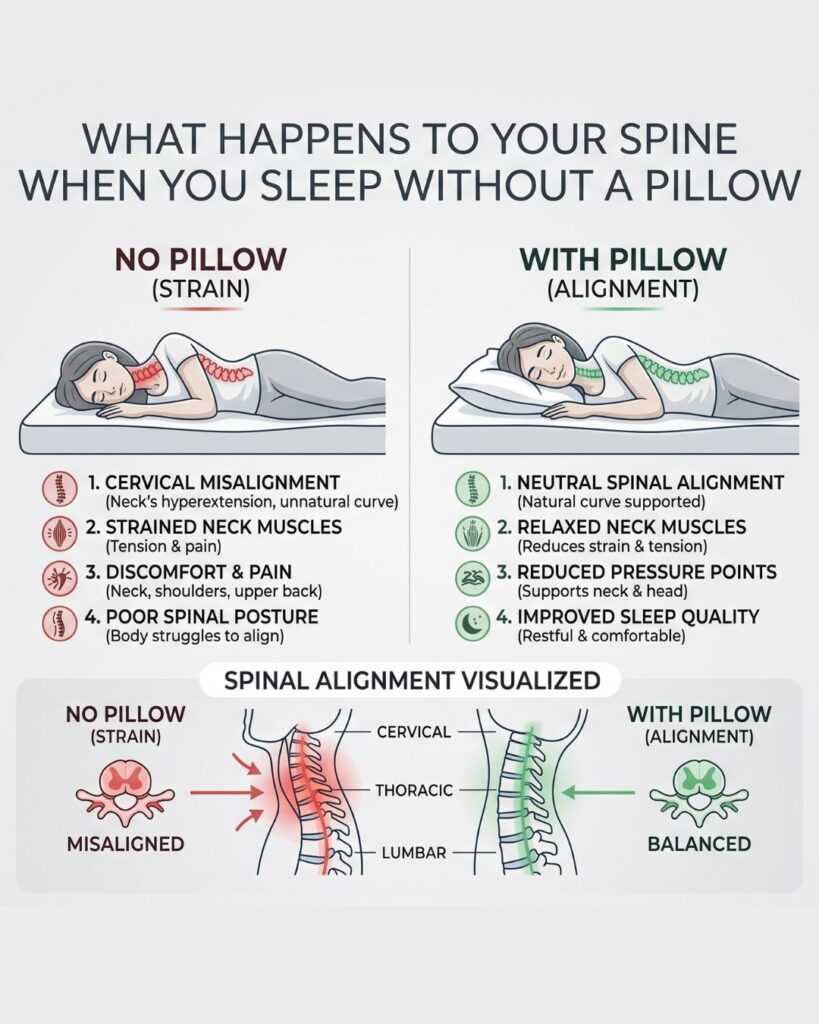
To understand the pillow question, you first need to understand what “neutral spine” means. In an ideal sleeping posture, your head, neck, and spine form one continuous, straight line — the same alignment you’d aim for when standing with good posture. A pillow’s job is to fill the gap between your head and the mattress so that your cervical spine (the seven vertebrae in your neck) stays in that neutral position.
When you remove the pillow, that gap doesn’t disappear — but its size changes dramatically depending on whether you’re on your back, side, or stomach. This is why blanket statements like “pillows are bad for you” or “you must always use a pillow” miss the point entirely. The effect of going pillow-free is entirely determined by your sleep position.
Research on spinal alignment during sleep is admittedly limited — there’s no large-scale randomized controlled trial comparing pillow users to non-pillow users. But what we do know from biomechanics and smaller studies paints a fairly clear picture. A neutral cervical spine position reduces stress on intervertebral discs, minimizes muscle strain, and allows the surrounding soft tissues to recover during sleep. Disrupt that alignment, and you’re asking your neck muscles to work overtime for seven to eight hours — which is rarely a recipe for waking up pain-free.
This same principle applies during the day, too. Just as ergonomic sitting posture protects your spine while you’re awake, your sleep posture does the same while you rest. Think of it as a 24-hour commitment to spinal health.
Sleeping Position Matters — a Lot
Back Sleepers: A Mixed Bag
When you sleep on your back, your head naturally tilts backward if there’s no pillow to support it. This hyperextends the cervical spine — essentially bending your neck in the opposite direction of its natural curve. For most back sleepers, this leads to morning stiffness, neck pain, and in some cases, tension headaches that radiate from the base of the skull.
There is one exception: if your pillow is excessively thick or firm, it can push your head too far forward, creating the opposite problem — cervical flexion that narrows the airway. In that specific scenario, removing the pillow or switching to a very thin one might actually improve breathing and reduce snoring. A 2026 study published in the British Journal of Ophthalmology even found that sleeping with fewer pillows (or none) was associated with lower intraocular pressure in glaucoma patients, potentially because elevated head positions can compress the jugular vein.
But for the average back sleeper with a properly fitted pillow? Going without one is more likely to cause problems than solve them. A low-loft pillow — roughly 3 to 5 inches thick — typically provides the sweet spot for neutral alignment.
Side Sleepers: The Highest Risk Group
Side sleeping is the most common sleep position — roughly 60% of adults sleep on their side — and it’s also the position where going pillow-free causes the most harm. When you lie on your side without a pillow, your head drops toward the mattress, creating a sharp lateral angle in your neck. Your shoulder bears the brunt of your upper body weight, and your cervical spine is forced into an unnatural side-bend for hours at a time.
The result? Side sleepers who ditch their pillow often wake up with neck pain, shoulder soreness, and sometimes numbness or tingling in the arm from nerve compression. Over time, this chronic misalignment can contribute to systemic inflammation — your body’s stress response to ongoing physical strain.
Side sleepers need the most pillow support of any position — typically a medium-to-high loft (4 to 6 inches) to fill the gap between the ear and the outer edge of the shoulder. If you’re looking to find pillows that work for side sleeping, look for contoured or cervical designs that cradle the neck while accommodating the shoulder. A body sleep pillow placed between the knees adds another layer of alignment by preventing the top leg from pulling your pelvis and lower spine out of position.
Stomach Sleepers: The One Group That May Benefit
If there’s one sleep position where going pillow-free makes biomechanical sense, it’s stomach sleeping. When you sleep face-down, a pillow forces your neck into extension (tilted back) and rotation (turned to one side). Remove the pillow, and your head can rest closer to the mattress, reducing that awkward angle. Some stomach sleepers report significant relief from neck tension and upper back pain after switching to no pillow — or to an ultra-thin pillow, under one inch thick.
That said, stomach sleeping itself isn’t ideal. It places your lumbar spine in extension and requires you to turn your head to breathe, which inherently twists the cervical spine. If you can transition to side or back sleeping, your spine will thank you. But if stomach sleeping is non-negotiable, going pillow-free (or nearly so) is your best bet for minimizing strain.
The Real Benefits of Going Pillow-Free
Beyond spinal alignment for stomach sleepers, the no-pillow lifestyle has a few evidence-informed perks worth mentioning — though some are more anecdotal than proven.
Fewer Sleep Wrinkles. When your face presses against a pillow for hours every night — especially as a side or stomach sleeper — the repeated compression and friction can contribute to “sleep lines.” These aren’t expression wrinkles (which come from muscle movement) — they’re caused by mechanical deformation of the skin. Sleeping on your back without a pillow eliminates face-to-surface contact entirely. Dermatologists generally agree that back sleeping is the most wrinkle-friendly position, though the effect is modest compared to factors like sun exposure and genetics.
Clearer Skin. Pillowcases accumulate oil, sweat, dead skin cells, and bacteria — all of which get pressed into your face for hours. If you’re prone to acne, going pillow-free (or at minimum, changing your pillowcase every 2–3 days) reduces that contact. Your nighttime skincare products also stay on your face instead of rubbing off onto fabric.
Neck Pain Relief — for Stomach Sleepers Only. This is the most legitimate biomechanical benefit. Stomach sleepers who switch to no-pillow often experience measurable improvement in neck pain and stiffness within days.
Possible Eye Health Benefits. As mentioned, the January 2026 glaucoma study adds an intriguing data point: reducing pillow height (or eliminating pillows) may help manage intraocular pressure. This is preliminary and specific to glaucoma patients — not a blanket recommendation — but it’s a fascinating area of emerging research.
The Risks Nobody Talks About
For the majority of sleepers — anyone who sleeps on their back or side — the risks of going pillow-free outweigh the benefits. Here’s what can go wrong:
Neck Pain and Tension Headaches. Without support, the neck muscles must contract isometrically all night to stabilize the head. This leads to muscle fatigue, trigger points, and referred pain — often felt as a tension headache at the base of the skull or behind the eyes.
Spinal Misalignment. The cervical spine has a natural lordotic curve (a gentle forward arch). Sleeping without a pillow on your back or side flattens or reverses this curve, putting pressure on discs and facet joints. Over weeks and months, this can contribute to degenerative changes.
Poor Sleep Quality. If you’re accustomed to a pillow, removing it can feel so foreign that it impairs your ability to fall asleep and stay asleep. And sleep architecture — the balance of REM, deep, and light sleep stages — is sensitive to physical comfort. Disrupted sleep has cascading effects on cognitive function, mood, immune response, and metabolic health.
Nerve Compression. Side sleepers without a pillow risk compressing the brachial plexus — the network of nerves that runs from the neck through the shoulder and down the arm. This can cause numbness, tingling, or “dead arm” sensations that wake you up at night.
Acid Reflux Worsening. If you have GERD or acid reflux, sleeping flat (with or without a pillow) allows stomach acid to flow more easily into the esophagus. In these cases, a wedge pillow or elevated head position is actually therapeutic — going pillow-free would be counterproductive.
Finding the Right Pillow for Your Sleep Position
For most people, the real question isn’t “pillow or no pillow?” — it’s “am I using the right pillow?” The differences between sleep positions are significant enough that a one-size-fits-all approach almost guarantees someone is sleeping wrong.
For Back Sleepers: Look for a pillow for back pain while sleeping with a low-to-medium loft (3–5 inches) and a contoured design that supports the natural curve of your neck without pushing your head forward. Memory foam cervical pillows excel here — they cradle the occipital region (the base of your skull) while providing a gentle roll under the neck. Avoid overly fluffy pillows that collapse overnight.
For Side Sleepers: This is where the best back and side sleeper pillow matters most. Side sleepers need a firmer, higher-loft pillow (4–6 inches) to bridge the shoulder gap. Contoured designs with a recessed area for the shoulder — sometimes called “side sleeper pillows” — help maintain that critical neutral alignment. Materials like shredded memory foam or latex offer the firmness and resilience that down or down-alternative pillows often lack for side sleepers. And don’t overlook the body sleep pillow: hugging one keeps your top arm from collapsing forward, and placing one between your knees prevents hip rotation that can lead to lower back pain.
For Stomach Sleepers: If you can’t switch positions, choose an ultra-thin pillow (under 2 inches) — or none at all. Some stomach sleepers find a very soft, compressible pillow placed under the forehead (not under the neck) allows them to breathe without cranking their neck to the side.
For Combination Sleepers: If you rotate between positions through the night, an adjustable-loft pillow lets you customize the fill level. Start with more fill (for side sleeping) and remove material until the pillow works in multiple positions.
The right pillow isn’t a luxury — it’s an essential piece of sleep equipment. If you’re struggling to find a pillow that genuinely works, consider that the best ways to improve sleep almost always start with the fundamentals: mattress quality, pillow support, room temperature, and light control. The pillow is just one piece, but it’s a critical one.
How to Transition to Pillow-Free Sleep (If You Want To Try)
If you’re curious about the no-pillow approach — especially as a stomach sleeper — don’t go cold turkey. Your body has adapted to your current setup, and an abrupt change can backfire.
- Start with a thinner pillow. Replace your current pillow with a folded towel or a very thin, compressible pillow. Use this for a week before removing it entirely.
- Pay attention to your mattress. A mattress that’s too soft will let your head sink, exaggerating misalignment. A firmer surface gives you more control.
- Track your symptoms. Note your morning neck stiffness, headache frequency, and sleep quality for two weeks. If things get worse, stop.
- Consider your sleeping position honestly. If you’re a side or back sleeper, the evidence strongly suggests you should keep a properly fitted pillow. The no-pillow route is primarily for stomach sleepers.
- Consult a professional if you have existing conditions. If you have cervical disc issues, scoliosis, chronic pain, or a history of whiplash, talk to a physical therapist or physician before changing anything.
And remember: sleep quality tips for better rest extend far beyond your pillow. Consistent bedtimes, cool room temperatures, and managing light exposure all play equally important roles in how well you sleep.
Bottom Line: Pillow or No Pillow?
The evidence points to a clear conclusion: for most adults, a well-chosen pillow supports healthy spinal alignment and better sleep quality. The exception is stomach sleepers, who may genuinely benefit from going pillow-free or using an ultra-thin option.
Here’s the quick-reference summary by sleep position:
- Back sleepers: Keep the pillow — low-to-medium loft, contoured support. Going without risks cervical hyperextension.
- Side sleepers: You need the most support. Medium-to-high loft, firm, contoured. Add a body pillow between the knees.
- Stomach sleepers: Go pillow-free or ultra-thin. This is the one position where ditching the pillow makes biomechanical sense.
- Combination sleepers: Adjustable-loft pillow. Customize for your dominant position.
If you wake up with neck pain, tension headaches, or numbness, your pillow — or lack thereof — is the first thing to audit. The right setup won’t fix every sleep problem, but the wrong one can certainly cause them.
Frequently Asked Questions
Is it better to sleep without a pillow?
It depends on your sleep position. Stomach sleepers may benefit from going pillow-free because it reduces neck extension. Back and side sleepers generally need a pillow to maintain neutral spinal alignment and prevent pain.
Can sleeping without a pillow reduce wrinkles?
Possibly. Back sleeping without a pillow eliminates face-to-surface contact, which reduces the mechanical compression that contributes to sleep wrinkles. However, the effect is modest — sun protection and skincare have a much larger impact on skin aging.
What pillow is best for back pain while sleeping?
For back sleepers with back pain, a low-to-medium loft contoured pillow that supports the cervical curve works best. For side sleepers, a firmer, higher-loft pillow that fills the shoulder gap — paired with a body pillow between the knees for hip alignment — provides the most comprehensive support.
What is the best pillow for a side and back sleeper?
The best back and side sleeper pillow typically has an adjustable loft so you can customize the height for both positions. Look for contoured designs with memory foam or latex fill that provide consistent support without collapsing overnight.
Can sleeping without a pillow cause neck pain?
Yes — in back and side sleepers, going pillow-free forces the cervical spine into an unnatural position, causing muscle strain, stiffness, and tension headaches. Stomach sleepers are the exception.
Are body pillows worth it?
Yes, especially for side sleepers and pregnant women. A body sleep pillow placed between the knees prevents the top leg from pulling your pelvis out of alignment, reducing strain on the lower back. Hugging one also prevents the top shoulder from collapsing forward.
Medically reviewed by Dr. A. Collins, MD — Board Certified Internist