
A friend of mine, 52, slipped getting out of the shower last year. One foot caught the bath mat, she went down on one knee, caught herself on the sink. No bones broken. She laughed it off. What she didn’t know was that the fall wasn’t about a slick floor. It was the first quiet signal of something that had been underway for two decades: her muscles were disappearing, and she had no idea.
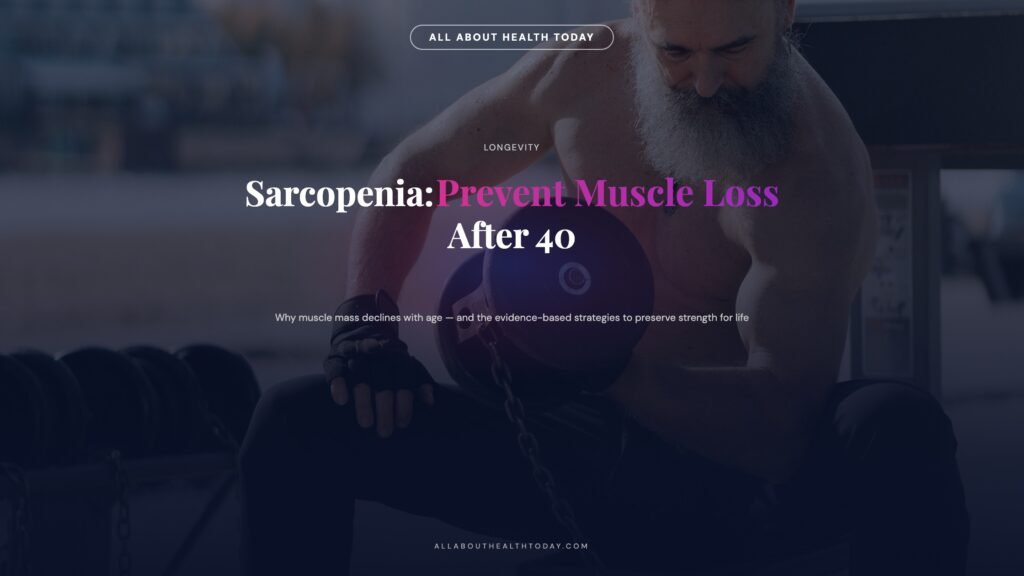
Sarcopenia — age-related muscle loss — strips away roughly 3 to 8% of your muscle mass per decade starting around age 30. After 60, the pace picks up. By 80, someone who never intervened might have lost half the muscle they carried at 25. In 2016, sarcopenia got its own ICD-10 code (M62.84), formally classifying it as a disease — not just “getting older,” not “slowing down,” not “well, what do you expect at that age.” It is a diagnosable, treatable, and partially reversible condition that begins decades before the first fall.
Medically Reviewed
This article was reviewed by Dr. A. Collins, MD — Board Certified Internist — to ensure medical accuracy and alignment with current clinical guidelines.
Muscle Is Metabolic Currency — Not Just Biceps
Most people think of muscle in aesthetic terms. That misses the point. Skeletal muscle is the body’s largest metabolic organ and your primary site for glucose disposal — roughly 80% of post-meal glucose gets taken up by muscle tissue. Every pound lost means less real estate to park blood sugar, which is one reason insulin resistance climbs in lockstep with muscle loss. Muscle is also your amino acid reservoir during illness. When the body faces trauma, surgery, or infection, it pulls amino acids from muscle for immune responses and tissue repair. Someone with plenty has a buffer. Someone without it struggles to recover.
Then there is the question that no one asks until it is too late: can you get yourself off the toilet at 85? That single test — standing from a seated position without using your hands — predicts disability and mortality more accurately than blood pressure or cholesterol. Muscle mass at 50 is the single best predictor of functional independence at 85. No pill, supplement, or clever biohack replaces it.
Beyond function, muscle acts as an endocrine organ, secreting myokines — signaling molecules that influence metabolism, inflammation, and even brain health — during contraction. Less muscle means fewer myokines. Sarcopenia reshapes your entire physiology, not just your strength.
How Sarcopenia Is Diagnosed
Diagnosis involves three measurements: strength, quantity, and performance. The European Working Group on Sarcopenia in Older People (EWGSOP2) guidelines start with low muscle strength as the primary indicator.
Grip strength. A handgrip dynamometer test takes about 30 seconds and is one of the strongest predictors of all-cause mortality in older adults. Cut-points generally fall below 27 kg for men and 16 kg for women. Grip strength correlates well with total body strength and flags problems years before functional decline becomes obvious.
Chair stand test. How long does it take to stand up and sit down five times without using your arms? More than 15 seconds suggests trouble. This tests the exact movement pattern that determines whether someone can live independently.
Gait speed. Walking at your usual pace over 4 meters. Below 0.8 meters per second is a red flag. Gait speed has been called the “sixth vital sign” — it integrates strength, balance, coordination, and cardiovascular fitness into one number that predicts falls and survival.
Body composition. DEXA scanning — the same technology used for bone density — quantifies lean mass with decent precision. Bioelectrical impedance scales sold for home use give rough estimates and are better at tracking trends than providing exact numbers.
The combination matters more than any single number. Low muscle mass on a scan with decent strength is not yet sarcopenia. Severe weakness with modest muscle loss is. Confirmed sarcopenia requires low strength plus low mass or quality; severe sarcopenia adds poor physical performance.
Why Muscle Disappears: The Biology of Sarcopenia
Anabolic resistance. This is the central mechanism. Muscle protein synthesis (MPS) is stimulated by eating protein, particularly the amino acid leucine. In young adults, 20 grams after a workout reliably flips the MPS switch on. In older adults, the same dose barely registers. Older muscle takes roughly twice the leucine to stimulate MPS to the same degree — a phenomenon that starts in your 40s and becomes pronounced after 60. If protein intake stays flat while muscles grow less responsive, you slide into negative protein balance — breaking down more muscle than you build, every day, for years.
Reduced protein intake. Appetite declines with age: changes in gut hormones, slower gastric emptying, altered taste and smell. Dental problems make chewing meat difficult. Fixed incomes push people toward cheaper, carbohydrate-heavy foods. Medications suppress appetite. A 2021 systematic review found roughly 30 to 50% of community-dwelling older adults eat less than the recommended protein. When anabolic resistance and low intake collide, muscle loss accelerates.
Sedentary behavior. “Use it or lose it” is cliché because it is true. Bed rest studies show healthy older adults lost roughly 1 kg of lean leg mass after just 10 days, with MPS dropping about 30%. A week and a half of lying down created measurable atrophy. Stretch that across years of sitting at desks, in cars, on couches — the cumulative effect is enormous. Every load you never lift is a signal your muscles interpret as permission to shrink.
Hormonal changes. Testosterone declines about 1% per year after 30 and directly drives muscle protein synthesis. For women, the hormonal story is just as important. Estrogen influences satellite cell activation, reduces inflammation, and protects mitochondrial function. Menopause, with its sharp drop in estrogen, is associated with accelerated muscle loss and a measurable decline in strength that begins in perimenopause. The muscle changes women notice in their late 40s and 50s are not imagined — they are biologically driven.
Chronic inflammation. The term “inflammaging” describes the low-grade, systemic inflammatory state that develops with age. Elevated cytokines like IL-6 and TNF-alpha directly promote muscle protein breakdown and make muscle less responsive to protein and exercise. Chronic conditions that raise baseline inflammation — obesity, diabetes, autoimmune disease — compound the damage. The same lifestyle habits that lower inflammation (regular exercise, adequate protein, sleep) also protect muscle.
The Protein Prescription
The standard RDA for protein — 0.8 grams per kilogram of body weight — was built to find the minimum to prevent deficiency, not the amount for optimal muscle health. For adults over 40, especially over 60, the evidence points to 1.2 to 1.6 grams per kilogram. For a 75 kg (165 lb) adult, that is 90 to 120 grams daily — substantially more than the 60 grams from the RDA. For guidance on structuring your intake throughout the day, see our guide on protein timing: how much and when.
Per-meal dosing matters. You cannot eat all your protein at dinner and expect the same anabolic response as spreading it across three meals. Muscle protein synthesis needs roughly 2.5 to 3 grams of leucine per meal — about 30 to 40 grams of high-quality protein. Older adults need the higher end because of anabolic resistance. A breakfast of toast and coffee might give you 5 grams. A lunch salad with chicken might hit 20. Both leave MPS unstimulated for most of the day. Three meals of 35 to 40 grams each get you to the sweet spot.
Leucine-rich sources. Whey protein is the gold standard — rapidly digested, leucine-dense, and efficient at stimulating MPS. Eggs, chicken, beef, and fish are excellent whole-food sources. Soy protein is the best plant-based option for leucine content, though it takes a larger serving to hit the leucine threshold. Most other plant proteins — beans, lentils, nuts — are lower in leucine and less bioavailable. Our breakdown of plant protein sources, from best to worst covers this in detail.
Timing after 60. The post-meal anabolic window stays open longer in older adults, but the peak is blunted. Spreading protein evenly across the day matters more, not less. A pre-sleep dose of 30 to 40 grams of casein or cottage cheese — slow-digesting proteins — improves overnight MPS in older adults and is worth considering if your dinner is earlier in the evening.

The Exercise Solution: Resistance Training Is Non-Negotiable
If protein is the raw material, resistance training is the construction crew that shows up and builds the house. Without the stimulus, protein alone cannot stop sarcopenia. Walking is great for cardiovascular health and mood — and does next to nothing for building or maintaining muscle mass. Muscle needs mechanical tension, close to failure, to signal adaptation.
Frequency and volume. Two to three sessions per week, covering the major movement patterns, is the sweet spot. The biggest gap is between doing nothing and doing something. Two sessions a week, done consistently, will maintain and often build muscle well into old age. For a practical starting point, see our guide to weight training for beginners.
Compound movements. Squats and deadlifts train the exact pattern of standing from a chair or picking something off the floor — which is why the toilet test at 85 is decided decades earlier in the gym. Pushing and pulling movements (bench press or push-ups, rows or pull-downs) keep the upper body functional for daily tasks like carrying groceries or pushing up from the floor. Isolation exercises have their place, but the foundation should be multi-joint movements — the way real life works.
Progressive overload. Muscles adapt to the demands placed on them and then stop. The stimulus has to increase — more weight, more reps, slower tempo, shorter rest — to keep driving adaptation. If you can comfortably complete every set, the weight is too light. The last two reps of each set should feel hard.
Power training. Strength is how much force you can produce. Power is how fast you can produce it. Explosive power declines roughly twice as fast as strength with age and is more predictive of falls. A 2022 meta-analysis found power training (moving moderate loads as fast as possible) reduced fall risk more than traditional slow-tempo training. The practical takeaway: during each rep, drive the weight up quickly — the lifting phase should be fast, the lowering phase slow and controlled. That combination builds strength and power in the same set.
The Synergy: Protein Plus Resistance Training
Either alone helps. Together, the effect is amplified. Resistance training makes muscle more sensitive to dietary protein — it lowers the anabolic resistance threshold, meaning older muscle responds more like younger muscle. Post-workout protein provides the raw material to repair and build the tissue training just signaled for growth. Doing one without the other is like having bricks but no bricklayer, or a bricklayer with no bricks.
Practical application: aim for 30 to 40 grams of protein within about two hours after a training session. The “anabolic window” was once described as 30 minutes or you miss it — that was overstated. The window is real but wider, and total daily protein matters more than exact timing. If you train fasted in the morning, eat protein soon after. If you had a protein-rich meal an hour or two before training, you are covered.
Other factors support the protein-training axis. Sleep deprivation directly impairs MPS and raises cortisol, which is catabolic to muscle. Managing metabolic health after 40 — insulin sensitivity, inflammation, hormonal status — creates the internal environment where muscle can respond to training. Even practices like yoga, which research shows can improve mobility and recovery, create conditions that support consistent training over decades. Sarcopenia prevention is not one thing. It is the sum of what you do most days, multiplied by years.
Frequently Asked Questions
At what age does sarcopenia start?
Muscle mass begins declining in the 30s at 3 to 5% per decade, accelerating after 60 to roughly 1 to 2% per year. Strength declines faster than mass — you can lose 30% of your strength while losing 10% of your muscle size. The process is gradual enough that most people do not notice until function is compromised, which is why habits in your 40s and 50s matter.
Can sarcopenia be reversed?
Partially, yes. You cannot turn a 70-year-old body into a 25-year-old body, but you can rebuild significant muscle mass and strength at almost any age. Studies of resistance training in 80- and 90-year-olds, including nursing home residents, show measurable gains in muscle size, strength, and functional capacity. The ceiling is lower than at 25, but the gap between doing nothing and doing something is larger at 75 than at 35. Reversal requires both adequate protein and progressive resistance training — neither alone is enough.
Is walking enough to prevent muscle loss?
No. Walking is excellent for cardiovascular health, mood, blood sugar regulation, and overall longevity. It does not provide the mechanical overload required to stimulate muscle protein synthesis or halt sarcopenia. A daily walk and a twice-weekly strength session cover different physiological needs. Think of cardio and resistance training as separate tools for separate jobs — you need both.
How much protein do older adults need?
The consensus among sarcopenia researchers is 1.2 to 1.6 grams per kilogram per day, distributed across meals at roughly 30 to 40 grams each. Someone weighing 70 kg (154 lbs) should target 84 to 112 grams daily — higher than the general RDA of 0.8 g/kg. For those with kidney disease, protein intake should be discussed with a physician.
Can you build muscle after 60?
Yes. Older muscles are less sensitive to protein and training stimuli, but they still respond. A 2019 meta-analysis of resistance training in adults over 60 found significant increases in lean body mass and strength across all age subgroups, including those over 80. Older adults need higher per-meal protein doses to stimulate MPS, and recovery between sessions takes longer. Train hard, eat enough protein, and give yourself an extra rest day compared to what you did at 30.
What is the difference between sarcopenia and osteoporosis?
Sarcopenia is the loss of muscle mass, strength, and function. Osteoporosis is the loss of bone mineral density, making bones fragile. They frequently travel together — the term “osteosarcopenia” describes the combined condition — because the same factors drive both: hormonal changes, inactivity, poor nutrition, and chronic inflammation. Muscle pulls on bone during contraction, stimulating bone remodeling. When muscle weakens, the signal to maintain bone density weakens too. Resistance training and adequate protein protect both simultaneously. A DEXA scan can assess body composition and bone density in a single session.
Do women lose muscle differently than men?
The fundamental biology is the same — anabolic resistance, disuse, inflammation — but menopause accelerates the timeline. Estrogen is protective for muscle, and its sharp decline during the menopausal transition is associated with measurable losses in strength and lean mass independent of aging alone. Women start from a lower peak of muscle mass, so they hit the threshold where function becomes compromised sooner. The prescription — adequate protein, consistent resistance training, power work — applies equally, but women should not wait until 65 to start.