
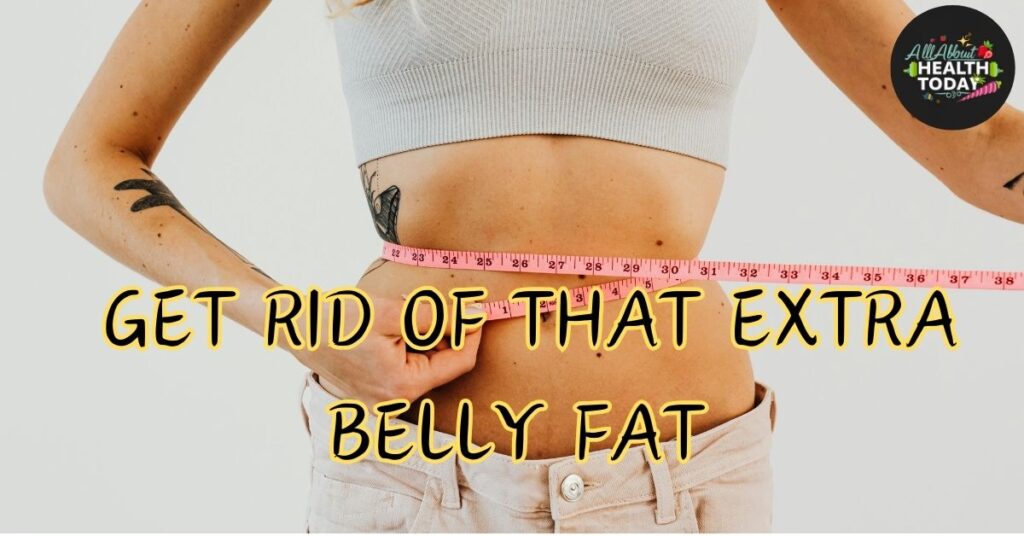
You cannot lose fat from your belly by exercising your belly, and you cannot lose meaningful fat in five days. What you can lose in five days is water and bloating, which is real but temporary. The rest of this article is about what actually shifts abdominal fat, why visceral fat matters more than the visible kind, and what the evidence says about the foods people are told will “speed up metabolism”.
The honest answer

Fat loss is systemic. When you are in an energy deficit, the body mobilises fat from stores across the body, and the pattern of where it comes off first is largely genetic and hormonal rather than something you can direct with exercise selection.
That is why crunches do not reduce belly fat, and why the people with the best abdominals are usually those with low overall body fat rather than those who do the most sit-ups.
What does work is unglamorous: a sustained energy deficit, enough protein to preserve muscle, resistance training to signal that the muscle is needed, and enough sleep to keep appetite regulation intact.
Two kinds of belly fat, and why one matters far more
Subcutaneous fat sits under the skin and is what you can pinch. Visceral fat wraps the organs inside the abdomen. They behave differently, and the difference is clinically important.
Visceral fat is metabolically active in a harmful way — it is associated with insulin resistance, inflammation and cardiovascular risk far more strongly than subcutaneous fat. It is also the fat that responds most readily to weight loss: during a diet, the proportion of visceral fat lost tends to exceed the proportion of subcutaneous fat lost (Chaston, 2008).
That is genuinely good news, and it is the opposite of what most people assume. The dangerous fat is the more responsive one. The detail on why it matters is in visceral fat and organ health.
The spot-reduction myth
The idea that training a muscle burns the fat overlying it has been tested directly. Comparing regional (targeted) aerobic exercise with general aerobic exercise, researchers examined molecular regulators of lipolysis and adipose tissue changes and found that the systemic effect dominates — fat mobilisation is driven by whole-body energy demand, not by which muscle is working (Zourmand, 2025).
Practically, that means:
- Crunches build abdominal muscle. They do not remove the fat covering it. That is a legitimate reason to do them, just not the one usually advertised.
- Training a limb does not slim that limb. The same principle applies to “inner thigh” and “arm” routines.
- Where fat comes off first is not under your control. This is why some people lose from the face and chest before the abdomen.
What actually works
| Lever | What the evidence shows | Relative importance |
|---|---|---|
| Energy deficit | The necessary condition for fat loss; nothing else substitutes for it | Essential |
| Aerobic exercise | Dose-response relationship between aerobic exercise volume and weight loss (Jayedi, 2024) | High |
| Resistance training | Preserves fat-free mass during restriction, which is where the deficit comes from (Deller, 2026) | High |
| Protein intake | Preserves lean mass and improves satiety during a deficit | High |
| Combining diet and exercise | Outperforms exercise alone for ectopic and visceral fat (Kazeminasab, 2025) | High |
| Sleep | Short sleep is associated with weight gain and altered appetite regulation (Muscogiuri, 2019) | Moderate |
| Specific “fat-burning” foods | Small or negligible effects at realistic intakes | Low |
Notice what is not on that list: detoxes, waist trainers, apple cider vinegar shots, and any product promising targeted abdominal fat loss. There is no mechanism by which any of them would work, and the burden of proof should sit with them.
Exercise that actually helps
Two types, doing different jobs:
Aerobic exercise creates the deficit and has a dose-response relationship with weight loss — more volume, up to a point, produces more loss (Jayedi, 2024). Walking is the most sustainable version of this for most people; the practical detail is in walking for weight loss.
Resistance training protects the muscle you have. During a calorie deficit the body will break down both fat and muscle; resistance training plus adequate protein biases that toward fat (Deller, 2026). Losing weight without it tends to produce a smaller but not leaner body.
Different exercise types do have differing effects on visceral fat, and the comparison in younger adults with obesity found that the type matters less than the total energy expenditure and adherence (Wang, 2022). Interval training is an efficient option and improves body composition comparably to continuous training (Poon, 2024) — the workouts themselves are in the home workout routines.
The foods, honestly
This is the part of the original article that needed correcting. It listed green tea, spicy peppers, lean protein, whole grains and fruit as foods that “speed up metabolism and burn belly fat”.
Most of those are good foods. But the framing is wrong: they do not meaningfully raise metabolic rate, and none of them burns fat independently of an energy deficit.
What is actually true is narrower and more useful: protein and fibre improve satiety, which makes a deficit easier to sustain. Green tea and capsaicin have small effects on energy expenditure that are real in a laboratory and irrelevant in a diet.

| Claim | Reality | Verdict |
|---|---|---|
| Green tea burns fat | Small, real effect on energy expenditure; negligible in practice without a deficit | Oversold |
| Capsaicin boosts metabolism | Measurable thermogenic effect, tiny magnitude | Oversold |
| Protein speeds metabolism | The thermic effect is real — protein costs more to digest — but the main benefit is satiety and lean mass | Partly true |
| Fibre helps you lose fat | Improves satiety and food volume; supports adherence to a deficit | Works indirectly |
| Cutting carbs targets belly fat | Low-carb diets work when they create a deficit, not because carbs were the problem | Misattributed |
The honest summary: eat enough protein to protect muscle, eat fibre for fullness, and let the deficit do the work. The protein numbers are in how much protein you need, and the broader food quality question is covered in foods that seem healthy but are not.
Sleep and stress: the variable people skip
Short sleep is associated with weight gain and with changes in appetite-regulating hormones that make overeating more likely (Muscogiuri, 2019). The causality runs both ways — obesity disrupts sleep and poor sleep promotes weight gain — but the practical implication is the same: a diet attempted on five hours of sleep is a harder version of the same diet.
Stress is the other half. Chronic stress tends to raise cortisol and, more importantly, to change eating behaviour toward higher-calorie foods. The hormonal pathways are complex and often oversimplified; the behavioural pathway is what matters most day to day. If sleep is your weak point, improving sleep is a fat-loss intervention, not a separate project.
What five days can actually do
So the honest framing of “5 days” is: five days is enough to reduce water retention and abdominal distension, and enough to establish the start of the process. It is not enough to change body composition visibly.
What a genuinely useful five days looks like:
- Reduce sodium and see the water weight come off within days.
- Set protein at a consistent target rather than aiming for perfection once.
- Walk daily — the easiest lever with real energy expenditure.
- Take a waist measurement and a baseline photo, because the scale is a noisy proxy.
- Fix one sleep behaviour, not all of them.
If you are losing weight through menopause, the hormonal picture changes the difficulty without changing the fundamentals — covered in menopause weight gain. If you have stalled after genuine progress, breaking a weight-loss plateau covers the adjustments worth making.
How to tell whether it is working
The scale is the worst single measure of abdominal fat change, because it conflates fat, muscle, glycogen and water. Two people can lose the same amount of fat and see very different scale results.
| Measure | What it captures | How often |
|---|---|---|
| Waist circumference | Abdominal fat change, independent of muscle gain elsewhere | Every 2 weeks, same time of day |
| Waist-to-height ratio | Central adiposity relative to frame; a better risk marker than BMI | Monthly |
| Progress photos | Shape change that mirrors obscure | Every 4 weeks, same light |
| Scale weight | Total mass, including water and glycogen | Weekly average, not daily |
| Strength on key lifts | Whether muscle is being preserved in the deficit | Monthly |
The reason to weigh weekly averages rather than daily readings is that day-to-day fluctuation from sodium, carbohydrate and menstrual cycle can easily exceed a week’s fat loss. A person who weighs daily and reacts to each number is measuring noise and calling it signal.
Waist circumference measured at the navel, relaxed, is the single most useful number here. A useful rule of thumb is that your waist should be less than half your height; above that, central adiposity is worth taking seriously regardless of what the scale says.
What a realistic timeline looks like
- Week 1: scale drops quickly from glycogen and water depletion. This is not fat and it will partly return.
- Weeks 2–4: fat loss becomes measurable at roughly 0.5% of body weight per week.
- Weeks 4–8: waist measurement starts to move; clothes fit differently before the mirror agrees.
- Weeks 8–12: visible change in abdominal shape if the deficit has been sustained.
- Beyond 12 weeks: the last abdominal fat typically comes off last, which is why persistence matters more than intensity.
If nothing has moved in four weeks by waist measurement and weekly average weight, the deficit is not real. That is the honest diagnostic, and it is more useful than adding another supplement.
Why the deficit estimate is usually wrong
Most people who believe they are in a deficit are not, for three predictable reasons. They under-report intake, they over-estimate exercise expenditure, and they do not account for the fact that a new exercise programme increases appetite. None of these is a character flaw; all are well documented in dietary self-report research.
The practical response is not a more precise app. It is to pick a smaller deficit that you can actually sustain, keep protein high enough to protect muscle, and measure the outcome over four weeks rather than four days. The chapter on plateaus in breaking a weight-loss plateau covers what to change when adherence is already good and progress has still stopped.
Common questions about belly fat
Can you target belly fat with exercise?
No. Spot reduction has been tested and does not work — fat mobilisation is systemic, driven by overall energy balance rather than by which muscle is working (Zourmand, 2025). Abdominal exercise builds abdominal muscle, which is a different goal.
How fast can I realistically lose belly fat?
A sustainable rate is roughly 0.5 to 1% of body weight per week. Faster than that usually means losing muscle and water. A reasonable deficit plus resistance training plus adequate protein produces steady loss without the rebound that rapid loss tends to cause.
Is walking enough?
It can be, particularly combined with a modest dietary deficit. Walking has a genuine dose-response relationship with weight loss and is the most sustainable aerobic option for most people. It is not as time-efficient as intervals, which is a trade-off rather than a problem.
Do waist trainers or belts work?
No. They compress tissue temporarily and do not affect fat stores. Any change disappears when you take them off.
Why is my belly fat not going away when I am losing weight?
Because the order in which you lose fat is largely genetic and hormonal. Many people lose from the extremities and face first and the abdomen last. It usually comes off eventually if the deficit continues — the pattern is about sequencing, not about something being broken.
Does cortisol cause belly fat?
Chronic cortisol excess (as in Cushing’s syndrome) causes central fat accumulation, but the ordinary “stress raises cortisol raises belly fat” story is oversimplified. For most people the pathway that matters is behavioural — stress changes what and how much you eat — rather than a direct hormonal deposit.
Sources
- Jayedi A, et al. Aerobic exercise and weight loss in adults: systematic review and dose-response meta-analysis. JAMA Netw Open. 2024. PMID 39724371
- Zourmand G, et al. Impact of regional and general aerobic exercise on molecular regulators of lipolysis and adipose tissue. Cell Mol Biol. 2025. PMID 41236293
- Chaston TB, Dixon JB. Factors associated with percent change in visceral versus subcutaneous abdominal fat during weight loss. Int J Obes. 2008. PMID 18180786
- Wang R, et al. Effects of different exercise types on visceral fat in young individuals with obesity. Front Physiol. 2022. PMID 36246116
- Poon ET, et al. Efficacy of interval training in improving body composition and adiposity in healthy adults. Sports Med. 2024. PMID 39003682
- Kazeminasab F, et al. Combined exercise training and dietary interventions versus exercise alone on ectopic fat. J Int Soc Sports Nutr. 2025. PMID 40619882
- Deller M, et al. Effects of calorie restriction with and without strength, endurance or mixed training on fat-free and skeletal muscle mass. Diabetes Obes Metab. 2026. PMID 42144246
- Muscogiuri G, et al. Obesity and sleep disturbance: the chicken or the egg? Crit Rev Food Sci Nutr. 2019. PMID 30335476